>
Acropomatiformes (Oceanic basses) >
Pempheridae (Sweepers)
Etymology: Parapriacanthus: Greek, para = near + Greek, prion = saw + Greek, akantha = thorn (Ref. 45335); rahah: Named for its type locality, Rahah Bay; noun in apposition.
Environnement : milieu / zone climatique / profondeur / gamme de distribution
Écologie
marin récifal; profondeur ? - 14 m (Ref. 107896). Tropical
Western Indian Ocean: Oman.
Taille / Poids / Âge
Maturité: Lm ? range ? - ? cm
Max length : 5.4 cm SL mâle / non sexé; (Ref. 107896); 5.3 cm SL (female)
Description synthétique
Clés d'identification | Morphologie | Morphométrie
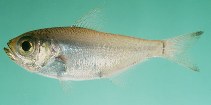
Épines dorsales (Total) : 6; Rayons mous dorsaux (Total) : 9; Épines anales: 3; Rayons mous anaux: 20 - 22. This species is characterized by the following: D VI,9; A III,20 (20-22); pectoral-fin rays 15-16 (often 16); lateral-line scales 65 (64-69); scale rows above lateral line to base of dorsal fin 5.5; gill rakers 25 (24-26, modally 25); body depth 3.2 (3.1-3.2) in SL, width 2.1 (2.0-2.15) in body depth; depth of caudal-peduncle 10.2 (9.5-10.1) in SL; head length 3.0 (2.85-3.0) in SL; snout length 12.2-12.9 in SL; relatively large eye, orbit diameter 7.5 (7.6-7.8) in SL with interorbital width 13.1 (12.0-14.0); mouth forming an angle of about 60° to horizontal axis of body; slender, recurved teeth in 2 irregular rows in upper row that project downward and becoming progressively smaller to end of the jaw; lower jaw with two medial rows of strongly recurved and inward-projecting teeth, reducing to a single row for remainder of jaw; vomer and palatines with small, incurved, sharply conical teeth in a single irregular row; thin upper lip, densely covered with dark purple papillae while lower lip has smaller, more widely spaced papillae; tongue broadly triangular, indented slightly on sides near tip, forming a small, rounded tip; predorsal length 2.5 (2.4-2.45) in SL; first dorsal-fin soft ray is longest, 4.4 (4.6-4.65) in SL; caudal fin forked with fin length 3.9 (3.95 and broken) in SL; pectoral-fin length 3.5 (3.45-3.55) in SL; prepelvic length 2.75 (2.5-2.7) in SL; pelvic fins not reaching the anus, fin length 5.0 (5.1-5.3) in SL; preanal length 1.55 (1.5-1.6) in SL; without a pin-like dark line anterior to anus; golden iris in preserved holotype (Ref. 107896).
Body shape (shape guide): short and / or deep; Cross section: compressed.
Collected from a cave in a drop-off by rotenone (Ref. 107896).
Cycle de vie et comportement reproducteur
Maturité | Reproduction | Frai | Œufs | Fécondité | Larves
Randall, J.E. and S.V. Bogorodsky, 2016. Preliminary review of the pempherid fish genus Parapriacanthus of the western Indian Ocean, with descriptions of five new species. J. Ocean Sci. Found. 20:1-24. (Ref. 107896)
Statut dans la liste rouge de l'IUCN (Ref. 130435: Version 2025-2 (Global))
Menace pour l'homme
Harmless
Utilisations par l'homme
Outils
Articles particuliers
Télécharger en XML
Sources Internet
Estimations basées sur des modèles
Indice de diversité phylogénétique (Réf.
82804): PD
50 = 0.5005 [Uniqueness, from 0.5 = low to 2.0 = high].
Bayesian length-weight: a=0.01479 (0.00642 - 0.03409), b=3.00 (2.80 - 3.20), in cm total length, based on LWR estimates for this (Sub)family-body shape (Ref.
93245).
Niveau trophique (Réf.
69278): 3.3 ±0.4 se; based on size and trophs of closest relatives
Résilience (Réf.
120179): Haut, temps minimum de doublement de population inférieur à 15 mois (Preliminary K or Fecundity.).
Vulnérabilité de la pêche (Ref.
59153): Low vulnerability (10 of 100).
🛈