>
Acropomatiformes (Oceanic basses) >
Pempheridae (Sweepers)
Etymology: Parapriacanthus: Greek, para = near + Greek, prion = saw + Greek, akantha = thorn (Ref. 45335); rahah: Named for its type locality, Rahah Bay; noun in apposition.
Ambiente: milieu / zona climatica / distribuzione batimetrica / gamma di distribuzione
Ecologia
marino associati a barriera corallina; distribuzione batimetrica ? - 14 m (Ref. 107896). Tropical
Western Indian Ocean: Oman.
Dimensione / Peso / Età
Maturità: Lm ? range ? - ? cm
Max length : 5.4 cm SL maschio/sesso non determinato; (Ref. 107896); 5.3 cm SL (female)
Breve descrizione
Chiavi di identificazione | Morfologia | Morfometria
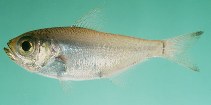
Spine dorsali (totale) : 6; Raggi dorsali molli (totale) : 9; Spine anali: 3; Raggi anali molli: 20 - 22. This species is characterized by the following: D VI,9; A III,20 (20-22); pectoral-fin rays 15-16 (often 16); lateral-line scales 65 (64-69); scale rows above lateral line to base of dorsal fin 5.5; gill rakers 25 (24-26, modally 25); body depth 3.2 (3.1-3.2) in SL, width 2.1 (2.0-2.15) in body depth; depth of caudal-peduncle 10.2 (9.5-10.1) in SL; head length 3.0 (2.85-3.0) in SL; snout length 12.2-12.9 in SL; relatively large eye, orbit diameter 7.5 (7.6-7.8) in SL with interorbital width 13.1 (12.0-14.0); mouth forming an angle of about 60° to horizontal axis of body; slender, recurved teeth in 2 irregular rows in upper row that project downward and becoming progressively smaller to end of the jaw; lower jaw with two medial rows of strongly recurved and inward-projecting teeth, reducing to a single row for remainder of jaw; vomer and palatines with small, incurved, sharply conical teeth in a single irregular row; thin upper lip, densely covered with dark purple papillae while lower lip has smaller, more widely spaced papillae; tongue broadly triangular, indented slightly on sides near tip, forming a small, rounded tip; predorsal length 2.5 (2.4-2.45) in SL; first dorsal-fin soft ray is longest, 4.4 (4.6-4.65) in SL; caudal fin forked with fin length 3.9 (3.95 and broken) in SL; pectoral-fin length 3.5 (3.45-3.55) in SL; prepelvic length 2.75 (2.5-2.7) in SL; pelvic fins not reaching the anus, fin length 5.0 (5.1-5.3) in SL; preanal length 1.55 (1.5-1.6) in SL; without a pin-like dark line anterior to anus; golden iris in preserved holotype (Ref. 107896).
Body shape (shape guide): short and / or deep; Cross section: compressed.
Collected from a cave in a drop-off by rotenone (Ref. 107896).
Ciclo vitale e comportamento di accoppiamento
Maturità | Riproduzione | Deposizione | Uova | Fecondità | Larve
Randall, J.E. and S.V. Bogorodsky, 2016. Preliminary review of the pempherid fish genus Parapriacanthus of the western Indian Ocean, with descriptions of five new species. J. Ocean Sci. Found. 20:1-24. (Ref. 107896)
Stato della Lista Rossa IUCN (Ref. 130435: Version 2025-2 (Global))
Minaccia per l'uomo
Harmless
Usi umani
Strumenti
Rapporti speciali
Scarica XML
Fonti Internet
Stime basate su modelli
Indice di diversità filogenetica (Fonte Biblio.
82804): PD
50 = 0.5005 [Uniqueness, from 0.5 = low to 2.0 = high].
Bayesian length-weight: a=0.01479 (0.00642 - 0.03409), b=3.00 (2.80 - 3.20), in cm total length, based on LWR estimates for this (Sub)family-body shape (Ref.
93245).
Livello trofico (Fonte Biblio.
69278): 3.3 ±0.4 se; based on size and trophs of closest relatives
Resilienza (Fonte Biblio.
120179): Alto, tempo minimo di raddoppiamento della popolazione meno di 15 mesi (Preliminary K or Fecundity.).
Vulnerabilità della pesca (Ref.
59153): Low vulnerability (10 of 100).
🛈