Élasmobranches (requins et raies) (sharks and rays) >
Myliobatiformes (Stingrays) >
Zanobatidae (Panrays)
Etymology: maculatus: Name from Latin 'macula' for spotted; referring to its blotched colour pattern.
Environnement : milieu / zone climatique / profondeur / gamme de distribution
Écologie
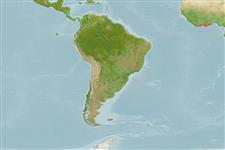
marin démersal; profondeur 1 - 30 m (Ref. 116736). Tropical; 6°N - 5°S, 8°W - 11°E (Ref. 114953)
Distribution
Territoires | Zones FAO | Écosystèmes | Occurrences | Carte par point | Introductions | Faunafri
Eastern Central Atlantic: Gulf of Guinea, from Ivory Coast to Gabon.
Taille / Poids / Âge
Maturité: Lm ? range ? - ? cm
Max length : 35.9 cm TL mâle / non sexé; (Ref. 116736)
Description synthétique
Clés d'identification | Morphologie | Morphométrie
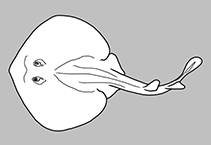
This species is distinguished from its congener (Zanobatus schoenleinii) by the following combination of characters: dorsal surface of disc is brownish to reddish brown, with numerous dark brown blotches, and sometimes surrounded by a network of whitish dots; the ventral surface of disc is pale creamy white or orange-brown, with conspicuous dark brown posterolateral margins; the crown of dermal denticles of dorsal surface spearhead-shaped; dorsal surface with enlarged thorny denticles are more numerous and stronger, in parallel rows on trunk and in concentric semi-circular rows on pectoral fins; tooth rows in upper jaw 54-64 ; predorsal vertebrae 36-44 (mode 39) (Ref. 116736).
Body shape (shape guide): other; Cross section: flattened.
Lives mostly on sandy bottoms (Ref. 116736).
Cycle de vie et comportement reproducteur
Maturité | Reproduction | Frai | Œufs | Fécondité | Larves
Séret, B., 2016. Zanobatus maculatus, a new species of panray from the Gulf of Guinea, eastern central Atlantic (Elasmobranchii: Batoidea: Zanobatidae). Zootaxa 4161(4):509-522. (Ref. 116736)
Statut dans la liste rouge de l'IUCN (Ref. 130435: Version 2025-2 (Global))
Menace pour l'homme
Harmless
Utilisations par l'homme
Outils
Articles particuliers
Télécharger en XML
Sources Internet
Estimations basées sur des modèles
Indice de diversité phylogénétique (Réf.
82804): PD
50 = 1.0000 [Uniqueness, from 0.5 = low to 2.0 = high].
Bayesian length-weight: a=0.01000 (0.00244 - 0.04107), b=3.04 (2.81 - 3.27), in cm total length, based on all LWR estimates for this body shape (Ref.
93245).
Niveau trophique (Réf.
69278): 3.4 ±0.5 se; based on size and trophs of closest relatives
Vulnérabilité de la pêche (Ref.
59153): Low to moderate vulnerability (26 of 100).
🛈