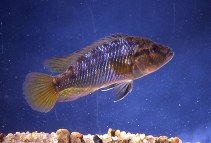
>
Cichliformes (Cichlids, convict blennies) >
Cichlidae (Cichlids) > Pseudocrenilabrinae
Etymology: Pseudocrenilabrus: Greek, pseudes = false + Latin, crenulatus = cut + Latin, labrum = lip (Ref. 45335).
More on author: Weber.
Milieu: milieu / Klimaatzone / Diepte / verspreidingsgebied
Ecologie
; zoet water benthopelagisch; pH range: 7.0 - ? ; dH range: 12 - ?. Tropical; 22°C - 25°C (Ref. 2059); 5°S - 35°S
Africa: from the Orange River system and southern KwaZulu-Natal northwards throughout southern Africa, extending to southern Congo basin tributaries (Ref. 7248, 52193) and lagoons and rivers associated with Lake Malawi, but not the lake itself (Ref. 55954). Also in Lake Rukwa (Ref. 27292). Three subspecies are recognized: Pseudocrenilabrus philander dispersus, Pseudocrenilabrus philander luebberti and Pseudocrenilabrus philander philander.
Grootte / Gewicht / Leeftijd
Maturiteit: Lm ? range ? - ? cm
Max length : 13.0 cm TL mannelijk / geslacht onbekend; (Ref. 52193); max. gerapporteerde leeftijd: 5 Jaren (Ref. 7248)
Korte beschrijving
Determinatiesleutels | Morfologie | Morfometrie
Dorsale stekels (totaal) : 13 - 16; Dorsale zachte stralen (totaal) : 9 - 11; Anale stekels: 3; Anale zachte stralen: 7 - 9.
Body shape (shape guide): fusiform / normal; Cross section: oval.
Found in various habitats, from flowing waters to lakes and isolated sinkholes, e.g., Lake Otjikoto, Namibia (see Ref. 27829); usually prefers vegetated zones. It feeds on insects, shrimps and even small fish (Ref. 52193). Breeds from early spring to late summer; males establish and defend a territory, construct a simple cleared nest and attract ripe females; eggs are laid in the nest, fertilized and collected by the female; the female withdraws to a quiet nursery area to brood the eggs, larvae and juveniles until they are able to fend for themselves (Ref. 7248, 52193). Ovophilic, agamous maternal mouthbrooder; no pair-bonding takes place (Ref. 52307).
Levenscyclus en paargedrag
Maturiteit | Voortplanting | Paaien | Eieren | Fecunditeit | Larven
Female lays batches of eggs on a substratum which the male begins to inseminate. Female collects the eggs almost immediately after laying a batch and incubates eggs in her mouth for 12-14 days at 26°C, releasing the young after which. Parent guards the young for 5-7 days, keeping them into her mouth when approached by predators or divers.
Skelton, P.H., 1991. Pseudocrenilabrus. p. 394-398. In J. Daget, J.-P. Gosse, G.G. Teugels and D.F.E. Thys van den Audenaerde (eds.) Check-list of the freshwater fishes of Africa (CLOFFA). ISNB, Brussels; MRAC, Tervuren; and ORSTOM, Paris. Vol. 4. (Ref. 5682)
Status op de Rode Lijst van het IUCN (Ref. 130435: Version 2025-2 (Global))
Gevaar voor de mens
Harmless
Gebruik door de mens
Visserij: van minder commercieel belang
Tools
Speciale rapporten
Download XML
Internetbronnen
Schattingen op basis van modellen
Fylogenetische diversiteitsindex (Ref.
82804): PD
50 = 0.5625 [Uniqueness, from 0.5 = low to 2.0 = high].
Bayesian length-weight: a=0.01259 (0.00749 - 0.02115), b=2.97 (2.83 - 3.11), in cm total length, based on LWR estimates for this species & (Sub)family-body (Ref.
93245).
Trofisch niveau (Ref.
69278): 3.7 ±0.60 se; based on food items.
Weerstandsvermogen (Ref.
120179): Gemiddeld, minimale populatieverdubbelingstijd 1,4-4,4 jaar (tmax=4.5).
Kwetsbaarheid van de visserij (Ref.
59153): Low vulnerability (10 of 100).
🛈
Voedingsstoffen (Ref.
124155): Calcium = 198 [107, 396] mg/100g; Iron = 1.7 [0.9, 3.4] mg/100g; Protein = 18.5 [17.0, 19.9] %; Omega3 = 0.575 [0.206, 1.673] g/100g; Selenium = 63.7 [24.5, 175.2] μg/100g; VitaminA = 65.3 [15.0, 213.0] μg/100g; Zinc = 2.35 [1.54, 3.63] mg/100g (wet weight);