>
Cichliformes (Cichlids, convict blennies) >
Cichlidae (Cichlids) > Pseudocrenilabrinae
Etymology: Pseudocrenilabrus: Greek, pseudes = false + Latin, crenulatus = cut + Latin, labrum = lip (Ref. 45335).
More on author: Weber.
Περιβάλλον: περιβάλλον / κλιματική ζώνη / εύρος βάθους / εύρος διανομής
Οικολογία
; Γλυκού νερού βενθοπελαγικό; pH range: 7.0 - ? ; dH range: 12 - ?. Tropical; 22°C - 25°C (Ref. 2059); 5°S - 35°S
Africa: from the Orange River system and southern KwaZulu-Natal northwards throughout southern Africa, extending to southern Congo basin tributaries (Ref. 7248, 52193) and lagoons and rivers associated with Lake Malawi, but not the lake itself (Ref. 55954). Also in Lake Rukwa (Ref. 27292). Three subspecies are recognized: Pseudocrenilabrus philander dispersus, Pseudocrenilabrus philander luebberti and Pseudocrenilabrus philander philander.
Μέγεθος / Βάρος / Ηλικία
Γεννητική Ωρίμανση: Lm ? range ? - ? cm
Max length : 13.0 cm TL αρσενικό/απροσδιόριστο; (Ref. 52193); μεγ. αναφερόμενη ηλικία: 5 έτη (Ref. 7248)
Σύντομη περιγραφή
Κλείδες προσδιορισμού | Μορφολογία | Μορφομετρία
Ραχιαίες άκανθες (συνολικά) : 13 - 16; Μαλακές ραχιαίες ακτίνες (συνολικά) : 9 - 11; Εδρικές άκανθες: 3; Μαλακές εδρικές ακτίνες: 7 - 9.
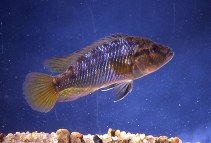
Body shape (shape guide): fusiform / normal; Cross section: oval.
Found in various habitats, from flowing waters to lakes and isolated sinkholes, e.g., Lake Otjikoto, Namibia (see Ref. 27829); usually prefers vegetated zones. It feeds on insects, shrimps and even small fish (Ref. 52193). Breeds from early spring to late summer; males establish and defend a territory, construct a simple cleared nest and attract ripe females; eggs are laid in the nest, fertilized and collected by the female; the female withdraws to a quiet nursery area to brood the eggs, larvae and juveniles until they are able to fend for themselves (Ref. 7248, 52193). Ovophilic, agamous maternal mouthbrooder; no pair-bonding takes place (Ref. 52307).
Κύκλος ζωής και συμπεριφορά ζευγαρώματος
Γεννητική Ωρίμανση | Αναπαραγωγή | Γεννοβολία | Αβγά | Γονιμότητα | Προνύμφες
Female lays batches of eggs on a substratum which the male begins to inseminate. Female collects the eggs almost immediately after laying a batch and incubates eggs in her mouth for 12-14 days at 26°C, releasing the young after which. Parent guards the young for 5-7 days, keeping them into her mouth when approached by predators or divers.
Skelton, P.H., 1991. Pseudocrenilabrus. p. 394-398. In J. Daget, J.-P. Gosse, G.G. Teugels and D.F.E. Thys van den Audenaerde (eds.) Check-list of the freshwater fishes of Africa (CLOFFA). ISNB, Brussels; MRAC, Tervuren; and ORSTOM, Paris. Vol. 4. (Ref. 5682)
Κατάσταση Κόκκινου Καταλόγου IUCN (Ref. 130435: Version 2025-2 (Global))
Απειλή για τον άνθρωπο
Harmless
Ανθρώπινες χρήσεις
αλιεία: περιορισμένης εμπορικότητας
Εργαλεία
Ειδικές εκθέσεις
Λήψη XML
Διαδικτυακές πηγές
Εκτιμήσεις βάσει μοντέλων
Δείκτης φυλογενετικής ποικιλότητας (Αναφ.
82804): PD
50 = 0.5625 [Uniqueness, from 0.5 = low to 2.0 = high].
Bayesian length-weight: a=0.01259 (0.00749 - 0.02115), b=2.97 (2.83 - 3.11), in cm total length, based on LWR estimates for this species & (Sub)family-body (Ref.
93245).
Τροφικό Επίπεδο (Αναφ.
69278): 3.7 ±0.60 se; based on food items.
Ελαστικότητα (Αναφ.
120179): Μεσαίο(α), ελάχιστος χρόνος για διπλασιασμό πληθυσμού 1,4 - 4,4 έτη (tmax=4.5).
Ευπάθεια στην αλιεία (Ref.
59153): Low vulnerability (10 of 100).
🛈
Θρεπτικά συστατικά (Ref.
124155): Calcium = 198 [107, 396] mg/100g; Iron = 1.7 [0.9, 3.4] mg/100g; Protein = 18.5 [17.0, 19.9] %; Omega3 = 0.575 [0.206, 1.673] g/100g; Selenium = 63.7 [24.5, 175.2] μg/100g; VitaminA = 65.3 [15.0, 213.0] μg/100g; Zinc = 2.35 [1.54, 3.63] mg/100g (wet weight);