>
Gobiiformes (Gobies) >
Gobiidae (Gobies) > Gobiinae
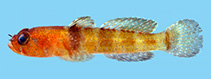
Etymology: Hetereleotris: Greek, heteros = other + The name of a Nile fish, eleotris (Ref. 45335); aurantiaca: Name from Latin ‘aurantiaca’ meaning ‘orange’, referring to the prevalence of orange color in head, body and fin-rays.
Environnement : milieu / zone climatique / profondeur / gamme de distribution
Écologie
marin récifal; profondeur 14 - 30 m (Ref. 121824). Tropical
Western Indian Ocean: Red Sea, Saudi Arabia.
Taille / Poids / Âge
Maturité: Lm ? range ? - ? cm
Max length : 1.5 cm SL (female)
Description synthétique
Clés d'identification | Morphologie | Morphométrie
Épines dorsales (Total) : 7; Rayons mous dorsaux (Total) : 10; Épines anales: 1; Rayons mous anaux: 9; Vertèbres: 33 - 34. This species is distimguished by the following characters: D VI + I,10; A I,9; pectoral-fin rays 14, all rays branched; pelvic-fin rays I,5, fin separated and no frenum, fifth ray unbranched; snout short, its length 0.7 of eye diameter; anterior nostril with a long nasal tube without process from the rim, posterior nostril pore with slightly erected rim; absence of tentacle above eye; posterior angle of jaws extending posteriorly to below posterior edge of pupil; opercular spine absent; without mental frenum; pelvic fins ending at anus, longer than pectoral fin; squamation reduced to a few ctenoid scales on caudal peduncle at caudal-fin base; absence of head canals; suborbital rows of papillae with 4 transverse rows; 3 distinct preorbital rows s present from posterior nostril to above upper lip; suborbital row 3 short, extending from eye ending distantly from row d; suborbital row 4 long, curving at ventroposterior edge of eye, extending obliquely below of level of row d; suborbital row b anteriorly not reaching to below posterior edge of eye; anterior dorsal rows o and m are present. Colour of head when alive and fresh orange, with body yellowish orange and with 5 faint, vertical, brown bands (Ref. 121824).
Cross section: oval.
This species is known only from the holotype which was collected at 14-16 m depth, from a steep coral-reef sloping down to about 30 m depth, where the upper half of the slope with short steps covered with hard and soft corals, and the specimen was collected at the entrance of small with cave (Ref. 121824).
Cycle de vie et comportement reproducteur
Maturité | Reproduction | Frai | Œufs | Fécondité | Larves
Kovačić, M., S.V. Bogorodsky and A.O. Mal, 2019. Two new species of Hetereleotris (Perciformes: Gobiidae) from the Red Sea. Zootaxa 4608(3):501-516. (Ref. 121824)
Statut dans la liste rouge de l'IUCN (Ref. 130435: Version 2025-2 (Global))
Menace pour l'homme
Harmless
Utilisations par l'homme
Outils
Articles particuliers
Télécharger en XML
Sources Internet
Estimations basées sur des modèles
Indice de diversité phylogénétique (Réf.
82804): PD
50 = 0.5000 [Uniqueness, from 0.5 = low to 2.0 = high].
Bayesian length-weight: a=0.00741 (0.00347 - 0.01582), b=3.09 (2.91 - 3.27), in cm total length, based on LWR estimates for this (Sub)family-body shape (Ref.
93245).
Niveau trophique (Réf.
69278): 3.0 ±0.3 se; based on size and trophs of closest relatives
Résilience (Réf.
120179): Haut, temps minimum de doublement de population inférieur à 15 mois (Preliminary K or Fecundity.).
Vulnérabilité de la pêche (Ref.
59153): Low vulnerability (10 of 100).
🛈