This website uses cookies to enhance your browsing experience and ensure the functionality of our site. For more detailed information about the types of cookies we use and how we protect your privacy, please visit our Privacy Information page.
×
Cookie Settings
This website uses different types of cookies to enhance your experience. Please select your preferences below:
分類 / 名稱 俗名 | 同種異名 | Catalog of Fishes(屬, 種) | ITIS | CoL | WoRMS | Cloffa
Teleostei > Siluriformes (Catfishes) 鯰形目 (Catfishes) > Loricariidae (Armored catfishes) 甲鯰科 (Armored catfishes) > Hypoptopomatinae
Etymology: Curculionichthys:Derived from the from the Latin 'curculionem' (elongated snout) and from the Greek 'ichthys' (fishes), in reference to the relatively elongated snouts of the fish species included in this genus; scaius:Name from Greek 'skaios', meaning west, westward, referring to the westerly distribution in the Brazilian Shield; an adjective.
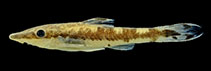
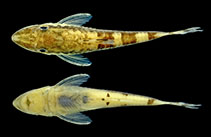
背棘 (總數) : 2; 背的軟條 (總數) : 7; 臀棘: 1; 臀鰭軟條: 5. This species is distinguished from its congeners by the following set of characters: having two usually distinct, somewhat triangular dark brown speckles lateral to the anal-fin origin (vs. speckles lateral to anal-fin origin absent or, when pigmentation present, weak and sparsely distributed forming inconspicuous blotches); differs from C. karipuna, Hisonotus acuen, H. chromodontus by having paired rostral plates (vs. rostral plate single); differs from C. oliveirai, C. piracanjuba, H. acuen, H. bockmanni, H. chromodontus by having more numerous lateral abdominal plates 7-8 (vs. 3-5 lateral abdominal plates); differs from C. coxipone, C. luteofrenatus, C. piracanjuba, C. sabaji, C. sagarana by having a single series of large median abdominal plates (vs. usually 3 or more regular series of median abdominal plates, or small plates irregularly distributed); differs from C. coxipone, C. sagarana by having anterior margin of snout pointed (vs. rounded); differs further from its congeners by having more dentary teeth 17-22 (vs. 5-1 in insperatus, 5-12,sabaji, 7-16 coxipone, 10-15 oliveirai, 11-18 itaim, 10-16 tukana, 4-7 paresi) and by having more pemaxillary teeth 19-25 (vs. 6-14 in insperatus, 7-13 sabaji, 7-15 coxipone, 9-18 oliveirai, 11-18 itaim, 12-18 tukana); also differs further in several morphometric proportions of the body and head, mostly involving prepelvic, prepectoral, and preanal distances, head and cleithral width, caudal peduncle length, and dorsal-fin spine (Ref. 119375). Cross section: oval.
This species was collected in a third order creek with clear water, bottom formed mainly by sand and leaf litter, wirh an average width of 2.5 m and depth of 0.3 m; collected when water temperature was 23.6 Celsius and dissolved oxygen 1.88 PPM. The creek edges were covered by gallery forest, but portions have been deforested and pastures are now reaching to the river margin (Ref. 119375).
Calegari, B.B., S.P. Gamarra and R.E. Reis, 2018. A new species of Curculionichthys (Siluriformes: Hypoptopomatinae) from the Western Border of the Brazilian Shield, Madeira River Basin, Brazil. Copeia 106(4):663-670. (Ref. 119375)
系統發育多樣性指數 (參考文獻 82804): PD50 = 0.5001 [Uniqueness, from 0.5 = low to 2.0 = high].
Bayesian length-weight: a=0.00977 (0.00434 - 0.02202), b=3.06 (2.87 - 3.25), in cm total length, based on LWR estimates for this (Sub)family-body shape (Ref. 93245).
營養階層 (參考文獻 69278): 2.7 ±0.1 se; based on size and trophs of closest relatives
回復力 (參考文獻 120179): 高度, 族群倍增時間少於 15個月 (Preliminary K or Fecundity.).
釣魚的脆弱性 (Ref. 59153): Low vulnerability (10 of 100). 🛈