>
Siluriformes (Catfishes) >
Loricariidae (Armored catfishes) > Hypoptopomatinae
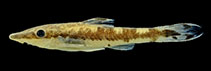
Etymology: Curculionichthys: Derived from the from the Latin 'curculionem' (elongated snout) and from the Greek 'ichthys' (fishes), in reference to the relatively elongated snouts of the fish species included in this genus; scaius: Name from Greek 'skaios', meaning west, westward, referring to the westerly distribution in the Brazilian Shield; an adjective.
Môi trường: môi trường / vùng khí hậu / Mức độ sâu / phạm vi phân phối
Sinh thái học
; nước ngọt gần đáy; mức độ sâu 0 - 1 m (Ref. 119375). Tropical
South America: Brazil.
Bộ gần gũi / Khối lượng (Trọng lượng) / Tuổi
Chín muồi sinh dục: Lm ? range ? - ? cm
Max length : 2.4 cm SL con đực/không giới tính; (Ref. 119375)
Mô tả ngắn gọn
Khóa để định loại | Hình thái học | Sinh trắc học
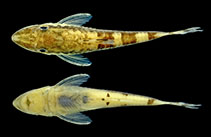
Các tia vây lưng cứng (tổng cộng) : 2; Các vây lưng mềm (tổng cộng) : 7; Tia cứng vây hậu môn: 1; Tia mềm vây hậu môn: 5. This species is distinguished from its congeners by the following set of characters: having two usually distinct, somewhat triangular dark brown speckles lateral to the anal-fin origin (vs. speckles lateral to anal-fin origin absent or, when pigmentation present, weak and sparsely distributed forming inconspicuous blotches); differs from C. karipuna, Hisonotus acuen, H. chromodontus by having paired rostral plates (vs. rostral plate single); differs from C. oliveirai, C. piracanjuba, H. acuen, H. bockmanni, H. chromodontus by having more numerous lateral abdominal plates 7-8 (vs. 3-5 lateral abdominal plates); differs from C. coxipone, C. luteofrenatus, C. piracanjuba, C. sabaji, C. sagarana by having a single series of large median abdominal plates (vs. usually 3 or more regular series of median abdominal plates, or small plates irregularly distributed); differs from C. coxipone, C. sagarana by having anterior margin of snout pointed (vs. rounded); differs further from its congeners by having more dentary teeth 17-22 (vs. 5-1 in insperatus, 5-12,sabaji, 7-16 coxipone, 10-15 oliveirai, 11-18 itaim, 10-16 tukana, 4-7 paresi) and by having more pemaxillary teeth 19-25 (vs. 6-14 in insperatus, 7-13 sabaji, 7-15 coxipone, 9-18 oliveirai, 11-18 itaim, 12-18 tukana); also differs further in several morphometric proportions of the body and head, mostly involving prepelvic, prepectoral, and preanal distances, head and cleithral width, caudal peduncle length, and dorsal-fin spine (Ref. 119375).
Cross section: oval.
This species was collected in a third order creek with clear water, bottom formed mainly by sand and leaf litter, wirh an average width of 2.5 m and depth of 0.3 m; collected when water temperature was 23.6 Celsius and dissolved oxygen 1.88 PPM. The creek edges were covered by gallery forest, but portions have been deforested and pastures are now reaching to the river margin (Ref. 119375).
Vòng đời và hành vi giao phối
Chín muồi sinh dục | Sự tái sinh sản | Đẻ trứng | Các trứng | Sự sinh sản | Ấu trùng
Calegari, B.B., S.P. Gamarra and R.E. Reis, 2018. A new species of Curculionichthys (Siluriformes: Hypoptopomatinae) from the Western Border of the Brazilian Shield, Madeira River Basin, Brazil. Copeia 106(4):663-670. (Ref. 119375)
Tình trạng Sách đỏ IUCN (Ref. 130435: Version 2025-2 (Global))
Mối đe dọa đối với con người
Harmless
Sử dụng của con người
Các nghề cá: không ích lợi (thú vị)
Các công cụ
Báo cáo đặc biệt
Tải xuống XML
Các nguồn internet
Ước tính dựa trên mô hình
Chỉ số đa dạng phát sinh loài (Tài liệu tham khảo
82804): PD
50 = 0.5001 [Uniqueness, from 0.5 = low to 2.0 = high].
Bayesian length-weight: a=0.00977 (0.00434 - 0.02202), b=3.06 (2.87 - 3.25), in cm total length, based on LWR estimates for this (Sub)family-body shape (Ref.
93245).
Mức dinh dưỡng (Tài liệu tham khảo
69278): 2.7 ±0.1 se; based on size and trophs of closest relatives
Thích nghi nhanh (Tài liệu tham khảo
120179): Chiêù cao, thời gian nhân đôi của chủng quần tối thiểu là dưới 15 tháng (Preliminary K or Fecundity.).
Sự dễ bị tổn thương của nghề đánh cá (Ref.
59153): Low vulnerability (10 of 100).
🛈