Clasificación / Nombres
Nombres comunes | Sinónimos | Catalog of Fishes(Género, Especie) | ITIS | CoL | WoRMS | Cloffa
>
Cichliformes (Cichlids, convict blennies) >
Cichlidae (Cichlids) > Pseudocrenilabrinae
Etymology: Otopharynx: Greek, ous = hear + Greek, pharyngx = pharynx (Ref. 45335); mumboensis: The name is an adjective referring to the type locality, Mumbo Island (Ref. 119408).
Entorno: milieu / zona climática / rango de profundidad / gama de distribución
Ecología
; agua dulce bentopelágico. Tropical
Africa: Mumbo Island, southwest arm of Lake Malawi, in Malawi (Ref. 119408).
Tamaño / Peso / Edad
Madurez: Lm ? range ? - ? cm
Max length : 11.6 cm SL macho / no sexado; (Ref. 119408)
Descripción breve
Claves de identificación | Morfología | Morfometría
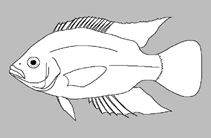
Espinas dorsales (total) : 16 - 17; Radios blandos dorsales (total) : 11; Espinas anales: 3; Radios blandos anales: 9 - 10. Diagnosis: A smallish laterally spotted haplochromine distinguished from most Otopharynx species by its suprapectoral spot, which is situated entirely below the upper lateral line and separated from it by about half the spot height; this spot is roughly rectangular, longitudinally elongate, 1-1.5 scales high, covering about seven consecutive scales, about three times as long as tall (Ref. 119408). The placement and shape of the suprapectoral spot immediately distinguish Otopharynx mumboensis from O. antron, O. argyrosoma, O. auromarginatus, O. decorus, O. heterodon, O. pachycheilus, O. selenurus, O. speciosus, O. spelaeotes, O. tetraspilus, and O. tetrastigma, all of which have the suprapectoral spot touching or usually extending above the upper lateral line, or may have no suprapectoral spot in O. selenurus; only O. brooksi, O. lithobates, and O. ovatus have a suprapectoral spot similar to that of O. mumboensis (Ref. 119408). Compared to O. brooksi, O. mumboensis has a shorter head, 31-32% of standard length vs. 36-39%, fewer outer teeth in the upper jaw, 47-50 vs. 69-87, and more gill rakers, 13 on lower limb vs. 11-12; compared to O. lithobates, O. mumboensis is deeper bodied, body depth 35.5-36.1% of standard length vs. 29.5-34.4%, has a shorter lower jaw, 35.7-36.2% of head length vs. 36.9-42.0%, and has a lower pharyngeal bone with all teeth of the median columns somewhat enlarged, with subcylindrical shafts and submolariform crowns vs. with slightly enlarged submolariform teeth confined to the posteromedian area; compared to O. ovatus, O. mumboensis has a shorter lower jaw, 35.7-36.2% of head length vs. 43.2-44.3%, larger eye, orbit length 34.8-35.4% of head length vs. 27.9-32.9%, narrower interorbital width, 22.6-24.0% of head length vs. 26.5-29.6%, more triangular lower pharyngeal bone with the posterior contour nearly straight vs. more Y-shaped and rather deeply notched posteriorly, and all teeth in the median columns of the lower pharyngeal bone somewhat molariform, the crowns broadened and flattened vs. the teeth in these columns bicuspid, their crowns not molarized (Ref. 119408).
Body shape (shape guide): short and / or deep.
Ciclo vital y comportamiento de apareamiento
Madurez | Reproducción | Puesta | Huevos | Fecundidad | Larva
Oliver, M.K., 2018. Six new species of the Cichlid genus Otopharynx from Lake Malaŵi (Teleostei: Cichlidae). Bulletin of the Peabody Museum of Natural History 59(2):159-197. (Ref. 119408)
Situación en la Lista Roja de la UICN (Ref. 130435: Version 2025-2 (Global))
Amenaza para el ser humano
Harmless
Usos humanos
Herramientas
Informes especiales
Descargar XML
Fuentes de Internet
Estimaciones basadas en modelos
Índice de diversidad filogenética (Referencia
82804): PD
50 = 0.5000 [Uniqueness, from 0.5 = low to 2.0 = high].
Bayesian length-weight: a=0.00389 (0.00180 - 0.00842), b=3.12 (2.94 - 3.30), in cm total length, based on all LWR estimates for this body shape (Ref.
93245).
Nivel trófico (Referencia
69278): 3.4 ±0.4 se; based on size and trophs of closest relatives
Resiliencia (Referencia
120179): Alto, población duplicada en un tiempo mínimo inferior a 15 meses (Preliminary K or Fecundity.).
Vulnerabilidad pesquera (Ref.
59153): Low vulnerability (10 of 100).
🛈