การจำแนกประเภท / ชื่อ
ชื่อสามัญ | ชื่อพ้อง | Catalog of Fishes(สกุล, ชนิด) | ITIS | CoL | WoRMS | Cloffa
>
Cichliformes (Cichlids, convict blennies) >
Cichlidae (Cichlids) > Pseudocrenilabrinae
Etymology: Otopharynx: Greek, ous = hear + Greek, pharyngx = pharynx (Ref. 45335); mumboensis: The name is an adjective referring to the type locality, Mumbo Island (Ref. 119408).
สิ่งแวดล้อม : สิ่งแวดล้อม / เขตภูมิอากาศ / ระดับความลึก / ระยะการกระจายสินค้า
นิเวศวิทยา
; น้ำจืด กลุ่มสัตว์หน้าดิน,กลุ่มสัตว์พื้นท้องน้ำ. Tropical
Africa: Mumbo Island, southwest arm of Lake Malawi, in Malawi (Ref. 119408).
ขนาด / น้ำหนัก / อายุ
วัยเจริญพันธุ์: Lm ? range ? - ? cm
Max length : 11.6 cm SL เพศผู้/กระเทย; (Ref. 119408)
คำอธิบายสั้นๆ
เครื่องมือที่ใช้ในการแยกชนิดสัตว์,สิ่งมีชีวิตออกจากกัน | สัณฐานวิทยา | ความยาวต่างๆ
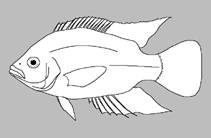
เงี่ยงครีบหลัง (รวม) : 16 - 17; ก้านครีบอ่อนที่หาง (รวม) : 11; เงี่ยงครีบก้น: 3; ก้านครีบอ่อนที่ก้น: 9 - 10. Diagnosis: A smallish laterally spotted haplochromine distinguished from most Otopharynx species by its suprapectoral spot, which is situated entirely below the upper lateral line and separated from it by about half the spot height; this spot is roughly rectangular, longitudinally elongate, 1-1.5 scales high, covering about seven consecutive scales, about three times as long as tall (Ref. 119408). The placement and shape of the suprapectoral spot immediately distinguish Otopharynx mumboensis from O. antron, O. argyrosoma, O. auromarginatus, O. decorus, O. heterodon, O. pachycheilus, O. selenurus, O. speciosus, O. spelaeotes, O. tetraspilus, and O. tetrastigma, all of which have the suprapectoral spot touching or usually extending above the upper lateral line, or may have no suprapectoral spot in O. selenurus; only O. brooksi, O. lithobates, and O. ovatus have a suprapectoral spot similar to that of O. mumboensis (Ref. 119408). Compared to O. brooksi, O. mumboensis has a shorter head, 31-32% of standard length vs. 36-39%, fewer outer teeth in the upper jaw, 47-50 vs. 69-87, and more gill rakers, 13 on lower limb vs. 11-12; compared to O. lithobates, O. mumboensis is deeper bodied, body depth 35.5-36.1% of standard length vs. 29.5-34.4%, has a shorter lower jaw, 35.7-36.2% of head length vs. 36.9-42.0%, and has a lower pharyngeal bone with all teeth of the median columns somewhat enlarged, with subcylindrical shafts and submolariform crowns vs. with slightly enlarged submolariform teeth confined to the posteromedian area; compared to O. ovatus, O. mumboensis has a shorter lower jaw, 35.7-36.2% of head length vs. 43.2-44.3%, larger eye, orbit length 34.8-35.4% of head length vs. 27.9-32.9%, narrower interorbital width, 22.6-24.0% of head length vs. 26.5-29.6%, more triangular lower pharyngeal bone with the posterior contour nearly straight vs. more Y-shaped and rather deeply notched posteriorly, and all teeth in the median columns of the lower pharyngeal bone somewhat molariform, the crowns broadened and flattened vs. the teeth in these columns bicuspid, their crowns not molarized (Ref. 119408).
Body shape (shape guide): short and / or deep.
วงจรชีวิตและพฤติกรรมการผสมพันธุ์
วัยเจริญพันธุ์ | การสืบพันธุ์ | การวางไข่ | เซลสืบพันธ์ของเพศเมีย(ไข่) | ความดกของไข่ | ตัวอ่อน
Oliver, M.K., 2018. Six new species of the Cichlid genus Otopharynx from Lake Malaŵi (Teleostei: Cichlidae). Bulletin of the Peabody Museum of Natural History 59(2):159-197. (Ref. 119408)
สถานะบัญชีแดงของ IUCN (Ref. 130435: Version 2025-2 (Global))
ภัยคุกคามต่อมนุษย์
Harmless
การใช้ของมนุษย์
เครื่องมือ
รายงานพิเศษ
ดาวน์โหลด XML
แหล่งที่มาจากอินเตอร์เน็ต
การประมาณค่าตามแบบจำลอง
ดัชนีความหลากหลายทางวิวัฒนาการ (อ้างอิง
82804): PD
50 = 0.5000 [Uniqueness, from 0.5 = low to 2.0 = high].
Bayesian length-weight: a=0.00389 (0.00180 - 0.00842), b=3.12 (2.94 - 3.30), in cm total length, based on all LWR estimates for this body shape (Ref.
93245).
ระดับชั้นอาหาร (อ้างอิง
69278): 3.4 ±0.4 se; based on size and trophs of closest relatives
ความสามารถในการกลับคืนสู่ปกติ (อ้างอิง
120179): ความสูง, เวลาต่ำสุดที่จะทำให้ประชากรเพิ่มขึ้นเป็น 2 เท่าใช้เวลาน้อยกว่า 15 เดือน (Preliminary K or Fecundity.).
ความเสี่ยงต่อการตกปลา (Ref.
59153): Low vulnerability (10 of 100).
🛈