Classification / Noms
Noms communs | Synonymes | Catalog of Fishes(Genre, Espèce) | ITIS | CoL | WoRMS | Cloffa
>
Characiformes (Characins) >
Anostomidae (Headstanders)
Etymology: Leporinus: Latin, lepus, leporis = rabbit (Ref. 45335); villasboasorum: Named for Orlando, Cláudio and Leonardo Villas-Bôas; noun in the genitive case.
Environnement : milieu / zone climatique / profondeur / gamme de distribution
Écologie
; eau douce benthopélagique. Tropical
South America: Brazil (Xingu and Tapajós rivers).
Taille / Poids / Âge
Maturité: Lm ? range ? - ? cm
Max length : 12.8 cm SL mâle / non sexé; (Ref. 119688)
Description synthétique
Clés d'identification | Morphologie | Morphométrie
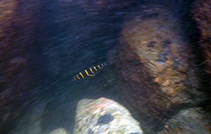
This species is distinguished from all its congeners except desmotes, jatuncochi, enyae by having a laterally compressed, elongate (more than twice as long as the second dentary tooth) tusk-like symphyseal dentary teeth (vs. the more truncate conical or incisiform teeth; less than twice as long as the second dentary tooth, typical of other congeners; differs from its congeners except bleheri, desmotes, enyae, jatuncochi, yophorus by the color pattern on the head and trunk consisting of 9 dark bars, some of which fork dorsally or ventrally, the fifth of which continues onto the dorsal and pelvic fins, (vs. various other color patterns in the approximately 90 other described species of Leporinus; differs most easily from jatuncochi and some specimens of desmotes by having 16 circumpeduncular scales (vs. 14); differs from enyae by having the dark bar anterior to the dorsal fin well-divided dorsally (vs. bar undivided or barely divided dorsally); similar in meristics and coloration to desmotes by having 16 circumpeduncular scales, but differs morphometrically with the most diagnostic are the shallower body depth of villasboasorum, 23.0-24.9% SL (vs. 25.1-28.9% SL) and the shorter distance from the pelvic-fin origin to adipose-fin origin 36.3-38.6% SL (vs. 38.5-43.4% SL) with the regression lines differing greatly between the species (Ref. 119688).
Cross section: compressed.
Cycle de vie et comportement reproducteur
Maturité | Reproduction | Frai | Œufs | Fécondité | Larves
Burns, M.D., M. Chatfield, J.L.O. Birindelli and B.L. Sidlauskas, 2017. Systematic assessment of the Leporinus desmotes species complex, with a description of two new species. Neotropical Ichthyology, 15(2):e160166[1-23]. (Ref. 119688)
Statut dans la liste rouge de l'IUCN (Ref. 130435: Version 2025-2 (Global))
Menace pour l'homme
Harmless
Utilisations par l'homme
Outils
Articles particuliers
Télécharger en XML
Sources Internet
Estimations basées sur des modèles
Indice de diversité phylogénétique (Réf.
82804): PD
50 = 0.5000 [Uniqueness, from 0.5 = low to 2.0 = high].
Bayesian length-weight: a=0.01023 (0.00469 - 0.02234), b=3.04 (2.86 - 3.22), in cm total length, based on LWR estimates for this Genus-body shape (Ref.
93245).
Niveau trophique (Réf.
69278): 2.5 ±0.1 se; based on size and trophs of closest relatives
Résilience (Réf.
120179): Haut, temps minimum de doublement de population inférieur à 15 mois (Preliminary K or Fecundity.).
Vulnérabilité de la pêche (Ref.
59153): Low vulnerability (10 of 100).
🛈