>
Characiformes (Characins) >
Anostomidae (Headstanders)
Etymology: Leporinus: Latin, lepus, leporis = rabbit (Ref. 45335); villasboasorum: Named for Orlando, Cláudio and Leonardo Villas-Bôas; noun in the genitive case.
Ambiente: milieu / zona climática / intervalo de profundidade / gama de distribuição
Ecologia
; Água doce bentopelágico. Tropical
South America: Brazil (Xingu and Tapajós rivers).
Tamanho / Peso / Idade
Maturidade: Lm ? range ? - ? cm
Max length : 12.8 cm SL macho/indeterminado; (Ref. 119688)
Descrição breve
Chaves de identificação | Morfologia | Morfometria
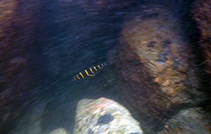
This species is distinguished from all its congeners except desmotes, jatuncochi, enyae by having a laterally compressed, elongate (more than twice as long as the second dentary tooth) tusk-like symphyseal dentary teeth (vs. the more truncate conical or incisiform teeth; less than twice as long as the second dentary tooth, typical of other congeners; differs from its congeners except bleheri, desmotes, enyae, jatuncochi, yophorus by the color pattern on the head and trunk consisting of 9 dark bars, some of which fork dorsally or ventrally, the fifth of which continues onto the dorsal and pelvic fins, (vs. various other color patterns in the approximately 90 other described species of Leporinus; differs most easily from jatuncochi and some specimens of desmotes by having 16 circumpeduncular scales (vs. 14); differs from enyae by having the dark bar anterior to the dorsal fin well-divided dorsally (vs. bar undivided or barely divided dorsally); similar in meristics and coloration to desmotes by having 16 circumpeduncular scales, but differs morphometrically with the most diagnostic are the shallower body depth of villasboasorum, 23.0-24.9% SL (vs. 25.1-28.9% SL) and the shorter distance from the pelvic-fin origin to adipose-fin origin 36.3-38.6% SL (vs. 38.5-43.4% SL) with the regression lines differing greatly between the species (Ref. 119688).
Cross section: compressed.
Ciclo de vida e comportamento de acasalamento
Maturidade | Reprodução | Desova | Ovos | Fecundidade | Larvas
Burns, M.D., M. Chatfield, J.L.O. Birindelli and B.L. Sidlauskas, 2017. Systematic assessment of the Leporinus desmotes species complex, with a description of two new species. Neotropical Ichthyology, 15(2):e160166[1-23]. (Ref. 119688)
Categoria na Lista Vermelha da IUCN (Ref. 130435: Version 2025-2 (Global))
Ameaça para o homem
Harmless
Utilização humana
Ferramentas
Relatórios especiais
Descarregue XML
Fontes da internet
Estimativas baseadas em modelos
Índice de diversidade filogenética (Ref.
82804): PD
50 = 0.5000 [Uniqueness, from 0.5 = low to 2.0 = high].
Bayesian length-weight: a=0.01023 (0.00469 - 0.02234), b=3.04 (2.86 - 3.22), in cm total length, based on LWR estimates for this Genus-body shape (Ref.
93245).
Nível Trófico (Ref.
69278): 2.5 ±0.1 se; based on size and trophs of closest relatives
Resiliência (Ref.
120179): Elevada, tempo mínimo de duplicação da população menor que 15 meses (Preliminary K or Fecundity.).
Vulnerabilidade da pesca (Ref.
59153): Low vulnerability (10 of 100).
🛈