Classification / Noms
Noms communs | Synonymes | Catalog of Fishes(Genre, Espèce) | ITIS | CoL | WoRMS | Cloffa
>
Cyprinodontiformes (Rivulines, killifishes and live bearers) >
Procatopodidae (African lampeyes) > Procatopodinae
Etymology: Hylopanchax: Greek, hylo, hyle = material, wood + Panchax, a word created by Meinken in 1932; thysi: The name thysi is in honour of Dirk Thys van den Audenaerde in recognition of his outstanding contributions to our knowledge on African ichthyology as well as for the many expeditions and resulting collections he made in Africa (Ref. 123864).
Eponymy: Professor Dr Dirk Frans Elisabeth Thys van den Audenerde (d: 1934) is a Belgian ichthyologist and Museum Director. [...] (Ref. 128868), visit book page.
Environnement : milieu / zone climatique / profondeur / gamme de distribution
Écologie
; eau douce pélagique. Tropical
Africa: Ivindo River drainage, a right-bank affluent of the Ogowe River basin, in Gabon (Ref. 123864).
Taille / Poids / Âge
Maturité: Lm ? range ? - ? cm
Max length : 2.3 cm SL mâle / non sexé; (Ref. 123864); 1.9 cm SL (female)
Description synthétique
Clés d'identification | Morphologie | Morphométrie
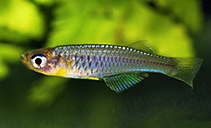
Épines dorsales (Total) : 0; Rayons mous dorsaux (Total) : 7 - 8; Épines anales: 0; Rayons mous anaux: 15 - 17; Vertèbres: 30. Diagnosis: Hylopanchax thysi is distinguished from all other Hylopanchax species, except H. paucisquamatus, by the presence of 30 vertebrae vs. 31-33 (Ref. 123864). It is further distinguished from H. paucisquamatus and all congeners except H. multisquamatus by the presence of a hyaline urogenital male papilla with small black spots vs. black, and the presence of a conspicuous reticulate pattern in the flank of both males and females vs. absence or less conspicuous; finally, H. thysi is distinguished from H. multisquamatus by a male caudal peduncle depth-length ratio between 53-59% vs. 40-45%, 24-26 scales in the midlongitudinal series vs. 27-30, 13-14 pectoral-fin rays vs. 11-12, body depth 25.2-27.8% of standard length vs. 20.0-23.7%, female predorsal length between 62.0-64.0% of standard length vs. 66.0-74.8%, and female prepelvic length of 33.7-38.0% of standard length vs. 42.1-45.1% (Ref. 123864).
Cross section: compressed.
Found in shallow creeks (Ref. 123864).
Cycle de vie et comportement reproducteur
Maturité | Reproduction | Frai | Œufs | Fécondité | Larves
Bragança, P.H.N., J.R. van der Zee, R. Sonnenberg and E.J.W.M.N. Vreven, 2021. Description of two new miniature species of Hylopanchax Poll & Lambert, 1965 (Cypriniformes: Procatopodidae) from northeastern Gabon, with an updated diagnosis of the genus based on morphology, colouration and osteology. J. Fish Biol. 98(3):655-667. (Ref. 123864)
Statut dans la liste rouge de l'IUCN (Ref. 130435: Version 2025-2 (Global))
Menace pour l'homme
Harmless
Utilisations par l'homme
Outils
Articles particuliers
Télécharger en XML
Sources Internet
Estimations basées sur des modèles
Indice de diversité phylogénétique (Réf.
82804): PD
50 = 0.5039 [Uniqueness, from 0.5 = low to 2.0 = high].
Bayesian length-weight: a=0.01122 (0.00514 - 0.02450), b=3.04 (2.87 - 3.21), in cm total length, based on all LWR estimates for this body shape (Ref.
93245).
Niveau trophique (Réf.
69278): 3.1 ±0.4 se; based on size and trophs of closest relatives
Vulnérabilité de la pêche (Ref.
59153): Low vulnerability (10 of 100).
🛈