>
Aulopiformes (Grinners) >
Paralepididae (Barracudinas)
Etymology: Arctozenus: Greek, arktos = bear + particle zen, derived from zao = to give life; risso: Named after A. Risso, European ichthyologist (Ref. 6885).
Eponymy: Professor Giovanni Antonio Risso (1777–1845) (aka Joseph Antoine Risso) was an Italian-French naturalist and the first to describe deep-sea fishes as distinctive fauna and describe depth zonation with different species living in discrete depth [...] (Ref. 128868), visit book page.
More on author: Bonaparte.
Taxonomic Remarks
Genus and spelling of species Eschmeyer, pers. comm. and in Paxton et al. 1989 (Ref.7300:247).
Περιβάλλον: περιβάλλον / κλιματική ζώνη / εύρος βάθους / εύρος διανομής
Οικολογία
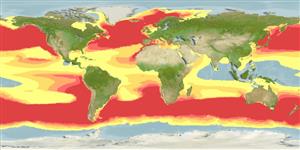
Θαλασσινό(ά) βαθυπελαγικό(ς); εύρος βάθους 0 - 2200 m (Ref. 50610). Deep-water; 71°N - 55°S, 180°W - 180°E
Worldwide distribution from the Arctic to Antarctic. Eastern Pacific: British Columbia (55°N) to at least north central Baja California (28°N) (Ref. 35950). Northwest Pacific: Bering Sea, Kamchatka, Kuril Islands (Ref. 41668).
Μέγεθος / Βάρος / Ηλικία
Γεννητική Ωρίμανση: Lm ? range ? - ? cm
Max length : 30.0 cm SL αρσενικό/απροσδιόριστο; (Ref. 35388); common length : 25.0 cm SL αρσενικό/απροσδιόριστο; (Ref. 4473)
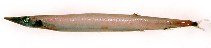
Ραχιαίες άκανθες (συνολικά) : 0; Μαλακές ραχιαίες ακτίνες (συνολικά) : 8 - 13; Εδρικές άκανθες: 0; Μαλακές εδρικές ακτίνες: 28 - 34; Σπόνδυλοι: 72 - 86. Bright silvery in color (Ref. 6885). Branchiostegal rays: 8 (Ref. 35950).
Body shape (shape guide): elongated.
Pseudoceanic and mesopelagic, occurring singly or in small schools (Ref. 5759), primarily at 200-1000 (Ref. 58302). Feed mainly on fishes and shrimps (Ref. 5759). Spawn in continental slopes and in oceanic banks from northern through tropical to southern temperate waters. Oviparous, with planktonic larvae (Ref. 35950).
Κύκλος ζωής και συμπεριφορά ζευγαρώματος
Γεννητική Ωρίμανση | Αναπαραγωγή | Γεννοβολία | Αβγά | Γονιμότητα | Προνύμφες
Post, A., 1990. Paralepididae. p. 373-384. In J.C. Quero, J.C. Hureau, C. Karrer, A. Post and L. Saldanha (eds.) Check-list of the fishes of the eastern tropical Atlantic (CLOFETA). JNICT, Lisbon; SEI, Paris; and UNESCO, Paris. Vol. 1. (Ref. 4473)
Κατάσταση Κόκκινου Καταλόγου IUCN (Ref. 130435: Version 2025-2 (Global))
Απειλή για τον άνθρωπο
Harmless
Ανθρώπινες χρήσεις
αλιεία: χωρίς ενδιαφέρον
Εργαλεία
Ειδικές εκθέσεις
Λήψη XML
Διαδικτυακές πηγές
Εκτιμήσεις βάσει μοντέλων
Προτιμώμενη θερμοκρασία (Αναφ.
123201): 0.8 - 10.8, mean 4.1 °C (based on 2120 cells).
Δείκτης φυλογενετικής ποικιλότητας (Αναφ.
82804): PD
50 = 0.7500 [Uniqueness, from 0.5 = low to 2.0 = high].
Bayesian length-weight: a=0.00186 (0.00078 - 0.00447), b=3.13 (2.92 - 3.34), in cm total length, based on LWR estimates for this (Sub)family-body shape (Ref.
93245).
Τροφικό Επίπεδο (Αναφ.
69278): 3.2 ±0.0 se; based on diet studies.
Ελαστικότητα (Αναφ.
120179): Μεσαίο(α), ελάχιστος χρόνος για διπλασιασμό πληθυσμού 1,4 - 4,4 έτη (Preliminary K or Fecundity.).
Ευπάθεια στην αλιεία (Ref.
59153): Low to moderate vulnerability (27 of 100).
🛈
Θρεπτικά συστατικά (Ref.
124155): Calcium = 49.9 [16.8, 160.1] mg/100g; Iron = 0.548 [0.182, 1.750] mg/100g; Protein = 15.6 [12.5, 18.2] %; Omega3 = 0.105 [0.029, 0.325] g/100g; Selenium = 27.5 [7.9, 78.4] μg/100g; VitaminA = 14.2 [1.6, 119.9] μg/100g; Zinc = 0.615 [0.321, 1.262] mg/100g (wet weight);