>
Aulopiformes (Grinners) >
Paralepididae (Barracudinas)
Etymology: Arctozenus: Greek, arktos = bear + particle zen, derived from zao = to give life; risso: Named after A. Risso, European ichthyologist (Ref. 6885).
Eponymy: Professor Giovanni Antonio Risso (1777–1845) (aka Joseph Antoine Risso) was an Italian-French naturalist and the first to describe deep-sea fishes as distinctive fauna and describe depth zonation with different species living in discrete depth [...] (Ref. 128868), visit book page.
More on author: Bonaparte.
Taxonomic Remarks
Genus and spelling of species Eschmeyer, pers. comm. and in Paxton et al. 1989 (Ref.7300:247).
Ambiente: milieu / zona climática / intervalo de profundidade / gama de distribuição
Ecologia
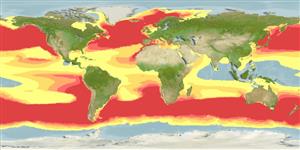
marinhas batipelágico; intervalo de profundidade 0 - 2200 m (Ref. 50610). Deep-water; 71°N - 55°S, 180°W - 180°E
Worldwide distribution from the Arctic to Antarctic. Eastern Pacific: British Columbia (55°N) to at least north central Baja California (28°N) (Ref. 35950). Northwest Pacific: Bering Sea, Kamchatka, Kuril Islands (Ref. 41668).
Tamanho / Peso / Idade
Maturidade: Lm ? range ? - ? cm
Max length : 30.0 cm SL macho/indeterminado; (Ref. 35388); common length : 25.0 cm SL macho/indeterminado; (Ref. 4473)
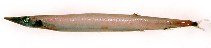
Espinhos dorsais (total) : 0; Raios dorsais moles (total) : 8 - 13; Espinhos anais: 0; Raios anais moles: 28 - 34; Vértebras: 72 - 86. Bright silvery in color (Ref. 6885). Branchiostegal rays: 8 (Ref. 35950).
Body shape (shape guide): elongated.
Pseudoceanic and mesopelagic, occurring singly or in small schools (Ref. 5759), primarily at 200-1000 (Ref. 58302). Feed mainly on fishes and shrimps (Ref. 5759). Spawn in continental slopes and in oceanic banks from northern through tropical to southern temperate waters. Oviparous, with planktonic larvae (Ref. 35950).
Ciclo de vida e comportamento de acasalamento
Maturidade | Reprodução | Desova | Ovos | Fecundidade | Larvas
Post, A., 1990. Paralepididae. p. 373-384. In J.C. Quero, J.C. Hureau, C. Karrer, A. Post and L. Saldanha (eds.) Check-list of the fishes of the eastern tropical Atlantic (CLOFETA). JNICT, Lisbon; SEI, Paris; and UNESCO, Paris. Vol. 1. (Ref. 4473)
Categoria na Lista Vermelha da IUCN (Ref. 130435: Version 2025-2 (Global))
Ameaça para o homem
Harmless
Utilização humana
Pescarias: sem interesse
Ferramentas
Relatórios especiais
Descarregue XML
Fontes da internet
Estimativas baseadas em modelos
Temperatura preferida (Ref.
123201): 0.8 - 10.8, mean 4.1 °C (based on 2120 cells).
Índice de diversidade filogenética (Ref.
82804): PD
50 = 0.7500 [Uniqueness, from 0.5 = low to 2.0 = high].
Bayesian length-weight: a=0.00186 (0.00078 - 0.00447), b=3.13 (2.92 - 3.34), in cm total length, based on LWR estimates for this (Sub)family-body shape (Ref.
93245).
Nível Trófico (Ref.
69278): 3.2 ±0.0 se; based on diet studies.
Resiliência (Ref.
120179): Médio, tempo mínimo de duplicação da população 1,4 - 4,4 anos (Preliminary K or Fecundity.).
Vulnerabilidade da pesca (Ref.
59153): Low to moderate vulnerability (27 of 100).
🛈
Nutrientes (Ref.
124155): Calcium = 49.9 [16.8, 160.1] mg/100g; Iron = 0.548 [0.182, 1.750] mg/100g; Protein = 15.6 [12.5, 18.2] %; Omega3 = 0.105 [0.029, 0.325] g/100g; Selenium = 27.5 [7.9, 78.4] μg/100g; VitaminA = 14.2 [1.6, 119.9] μg/100g; Zinc = 0.615 [0.321, 1.262] mg/100g (wet weight);