التصنيف / الأسماء
الأسماء الشائعة | مرادفات | Catalog of Fishes(جنس, الانواع) | ITIS | CoL | WoRMS | Cloffa
>
Cypriniformes (Carps) >
Cyprinidae (Minnows or carps) > Torinae
Etymology: nzadinkisi: The current name of the Inkisi River is derived from its local appellation 'Nzadi I nkisi' in Kikongo (Kintandu/Kindibu dialects), referring to the missionaries who threw the 'mi-nkisi', fetish object containing a certain nkisi spirit, in the river in their effort to convert the local populations to Christianity; species name referring to this new name of the river basin to which it appears endemic; in addition, by its reference to the nkisi-objects, indirectly referring to the enigmatic hybridization complex of which this species is a parental species; a noun in apposition, making its gender ending unchangeable (Ref. 127934).
البيئة: الوسط / المنطقة المناخية / نطاق العمق / نطاق التوزيع
البيئة
; المياه العذبة قاعية التغذية و المعيشة. Tropical
Africa: Inkisi River, Lower Congo River basin above the Zongo Falls, in Democratic Republic of the Congo (Ref. 127934).
الحجم / وزن / العمر
النضج: Lm ? range ? - ? cm
Max length : 20.5 cm SL ذكر/ مختلط الجنس; (Ref. 127934)
وصف مختصر
مفاتيح التعريف | الوصف الخارجي | قياسات المظهر الخارجي
الأشواك الظهرية (المجموع) : 0; الأشعة الظهرية الناعمة (المجموع) : 14 - 16; شوكة شرجية: 0; أشعه شرجية لينه: 9; فقرات: 37 - 38. Diagnosis: Within the Congo basin Labeobarbus nzadinkisi can be distinguished from L. altipinnis, L. ansorgii, L. batesii, L. brauni, L. cardozoi, L. caudovittatus, L. dartevellei, L. fasolt, L. habereri, L. humphri, L. iphthimostoma, L. iturii, L. jubbi, L. longidorsalis, L. longifilis, L. lufupensis, L. macroceps, L. macrolepidotus, L. macrolepis, L. mawambi, L. mawambiensis, L. mirabilis, L. nanningsi, L. oxyrhynchus, L. paucisquamatus, L. stappersii, L. trachypterus, L. upembensis and L. wittei by its high number of lateral line scales, 35-41 vs. less than 34; from L. leleupanus by its low number of lateral line scales, 35-41 vs. 45-47; from L. tropidolepis and L. platyrhinus by its low number of scales between the lateral line and the dorsal and ventral midline, 4.5-5.5 and 5.5 vs. 7.5-8.5 and 7.5-9.5 in L. tropidolepis and 6.5-7.5 and 6.5-8.5 in L. platyrhinus, and from the latter by its low number of circumpeduncular scales as well, 12-14 vs. 16-18; from L. robertsi by the absence of papillae on the anterior edge of the lower jaw vs. with numerous well identifiable papillae; from L. progenys by its non-prognathous lower jaw vs. prognathous; from L. altianalis, L. gestetneri and L. somereni by its lack of both pairs of barbels vs. two pair of well-developed barbels; and from L. pellegrini by its short prepelvic length, 46.5-48.5% of standard length vs. 50.6%, its short pelvic length, 17.9-21.0% of standard length vs. 21.8%, and its large eye, 29.1-34.6% of head length vs. 27.1% (Ref. 127934). Further, L. nzadinkisi can be distinguished from the other members of the Inkisi complex, L. nzadimalawu and the intermediate/hybrid specimens by the presence of a cornified Varicorhinus real cutting edge on the outer edge of the lower jaw in combination with the absence of barbels and poorly developed fleshy lips on the lateral side of the lower jaw vs. never with a cutting edge but instead always with a free mental lobe in combination with two pairs of well-developed barbels and well-developed fleshy lips in L. nzadimalawu; although a cornified Varicorhinus real cutting edge can be found in some specimens, this most often in combination with at leats a single pair of well-developed barbels and well-developed fleshy lips in the hybrid specimens; in addition, L. nzadinkisi can be distinguished from L. nzadimalawu by its broad mouth width, 26.8-50.5% of head length vs. 16.1-26.5%, short head length, 20.1-22.1% of standard length vs. 23.0-26.4%, long dorsal-fin base length, 14.4-17.9% of standard length vs. 12.1-16.0%, and short prepectoral distance, 20.0-22.1% of standard length vs. 22.6-26.0% (Ref. 127934). Finally, L. nzadinkisi can be distinguished from Acapoeta tanganicae by its low number of lateral line scales, 35-41 vs. 57-67 (Ref. 127934). Within the adjacent Lower Guinea ichthyofaunal province, L. nzadinkisi can be distinguished from L. axelrodi, L. batesii, L. brevispinis, L. cardozoi, L. caudovittatus, L. compiniei, L. habereri, L. fimbriatus, L. jaegeri, L. malacanthus, L. mariae, L. mbami, L. micronema, mungoensis, L. roylii, L. sandersi, L. semireticulatus, L. steindachneri, L. tornieri, L. versluysii and L. werneri by its higher number of lateral line scales, 35-41 vs. less than 34; from L. aspius, L. lucius and L. progenys by its non-prognathous lower jaw vs. lower jaw clearly prognathous; and from L. rocadasi by its last unbranched dorsal-fin ray not being transformed into a well-developed spine, but instead being clearly segmented over approximately half its length, or 43.0-50.1% of dorsal-fin height vs. last unbranched dorsal-fin ray transformed into a spine, clearly segmented only at its most distal end; finally, L. nzadinkisi can be distinguished from Sanagia velifera by its high number of lateral line scales, 35-41 vs. 22-24 (Ref. 127934). Within the adjacent Quanza ichthyofaunal province, L. nzadinkisi can be distinguished from L. ansorgii, L. gulielmi, L. jubbi, L. nanningsi, L. rhinophorus, L. rosae and L. roylii by its high number of lateral line scales, 35-41 vs. less than 34; from L. clarkeae, L. ensifer and L. varicostoma by the absence of papillae on the anterior edge of the lower jaw vs. with well identifiable papillae; from L. lucius and L. progenys by its non-prognathous lower jaw vs. lower jaw clearly prognathous; and from L. boulengeri, L. ensis, L. girardi, L. steindachneri, L. stenostoma and L. rocadasi by its last unbranched dorsal-fin ray not being transformed into a well-developed spine, but instead being clearly segmented over approximately half its length, or 43.0-50.1% of dorsal-fin height vs. last unbranched dorsal-fin ray transformed into a spine, clearly segmented only at its most distal end (Ref. 127934).
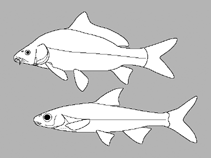
Body shape (shape guide): elongated.
دورة الحياة وسلوك التزاوج
النضج | التكاثر | وضع البيض | بيض | الخصوبة | اليرقات
Vreven, E.J.W.M.N., T. Musschoot, E. Decru, S. Wamuini Lunkayilakio, K. Obiero, A.F. Cerwenka and U.K. Schliewen, 2018. The complex origins of mouth polymorphism in the Labeobarbus (Cypriniformes: Cyprinidae) of the Inkisi River basin (Lower Congo, DRC, Africa): insights from an integrative approach. Zool. J. Linn. Soc. 186:414-482. (Ref. 127934)
حالة القائمة الحمراء للاتحاد الدولي لحفظ الطبيعة والموارد الطبيعية (Ref. 130435: Version 2025-2 (Global))
استخدامات بشرية
مصائد: غير ذات اهمية
أدوات
تقارير خاصة
تنزيل XML
مصادر علي الأنترنت
تقديرات تستند إلى النماذج
مؤشر التنوع الشُعبي الوراثي (مرجع
82804): PD
50 = 0.5000 [Uniqueness, from 0.5 = low to 2.0 = high].
Bayesian length-weight: a=0.00468 (0.00218 - 0.01003), b=3.10 (2.90 - 3.30), in cm total length, based on LWR estimates for this (Sub)family-body shape (Ref.
93245).
مستوى غذائي (مرجع
69278): 3.2 ±0.5 se; based on size and trophs of closest relatives
المرونه (مرجع
120179): وسيط, الحد الزمني الأدني لتضاعف عدد أفراد المجتمع 1.4-4.4 سنة (Preliminary K or Fecundity.).
ضعف الصيد (Ref.
59153): Low vulnerability (15 of 100).
🛈