Classificatie / Namen
Lokale namen | Synoniemen | Catalog of Fishes(Genus, Soort(en)) | ITIS | CoL | WoRMS | Cloffa
>
Cyprinodontiformes (Rivulines, killifishes and live bearers) >
Rivulidae (Rivulines) > Cynolebiinae
Etymology: guarani: Named for the Guaraní indigenous people, who live in several settlements very close to the type locality of this species, as a vindication of their culture and history.
Milieu: milieu / Klimaatzone / Diepte / verspreidingsgebied
Ecologie
; zoet water pelagisch; diepte 0 - 1 m (Ref. 129129). Tropical
South America: Argentina.
Grootte / Gewicht / Leeftijd
Maturiteit: Lm ? range ? - ? cm
Max length : 5.5 cm SL mannelijk / geslacht onbekend; (Ref. 129129); 3.8 cm SL (female)
Korte beschrijving
Determinatiesleutels | Morfologie | Morfometrie
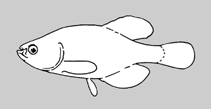
This species is distinguished from its congeners by having a unique colour pattern consisting of the following: mature males when alive with scattered small dark brown to grey irregular blotches on the laterodorsal surface of head and anterior portion of trunk, with many and relatively big sub-square irregular iridescent turquoise to light blue blotches on unpaired fins, evenly distributed, and those in the distal portion are elongated and merging, the trunk and tail with anterocentral part of scales iridescent turquoise with grey borders generating a reticulated pattern, the thin external border of the scales in the dorsal part of trunk, below the dorsal fin, are iridescent turquoise, and orange-yellowish background coloration on the base of unpaired fins and yellowish belly; in juveniles and young adults, anterior nostrils are ventrolaterally directed (Ref. 129129).
Body shape (shape guide): elongated; Cross section: compressed.
Found only in its type locality which is a seasonal pond, mainly covered with grass, in the Paraná Forest at ca.185 m a.s.l.. It is in an open space, in the surrounding jungle, with abundant palm trees. Maximum depth measured was ca. 80 cm, and the water was clear and no submerged aquatic vegetation was observed. The bottom is of soft sediment, with abundant organic
matter (Ref. 129129).
Levenscyclus en paargedrag
Maturiteit | Voortplanting | Paaien | Eieren | Fecunditeit | Larven
Alonso, F., G.E. Terán, W.S. Serra Alanís, P. Calviño, M.M. Montes, I.D. García, J.A. Barneche, A. Almirón, L. Ciotek, P. Giorgis and J. Casciotta, 2023. From the mud to the tree: phylogeny of Austrolebias killifishes, new generic structure and description of a new species (Cyprinodontiformes: Rivulidae). Zool. J. Linn. Soc. 199:280-309. (Ref. 129129)
Status op de Rode Lijst van het IUCN (Ref. 130435: Version 2025-2 (Global))
Gevaar voor de mens
Harmless
Gebruik door de mens
Visserij: van geen belang
Tools
Speciale rapporten
Download XML
Internetbronnen
Schattingen op basis van modellen
Fylogenetische diversiteitsindex (Ref.
82804): PD
50 = 0.5625 [Uniqueness, from 0.5 = low to 2.0 = high].
Bayesian length-weight: a=0.00617 (0.00266 - 0.01427), b=3.13 (2.93 - 3.33), in cm total length, based on LWR estimates for this (Sub)family-body shape (Ref.
93245).
Trofisch niveau (Ref.
69278): 3.2 ±0.4 se; based on size and trophs of closest relatives
Weerstandsvermogen (Ref.
120179): Hoog, minimale populatieverdubbelingstijd minder dan 15 maanden (Preliminary K or Fecundity.).
Kwetsbaarheid van de visserij (Ref.
59153): Low vulnerability (10 of 100).
🛈