>
Cyprinodontiformes (Rivulines, killifishes and live bearers) >
Rivulidae (Rivulines) > Cynolebiinae
Etymology: guarani: Named for the Guaraní indigenous people, who live in several settlements very close to the type locality of this species, as a vindication of their culture and history.
Môi trường: môi trường / vùng khí hậu / Mức độ sâu / phạm vi phân phối
Sinh thái học
; nước ngọt tầng nổi; mức độ sâu 0 - 1 m (Ref. 129129). Tropical
South America: Argentina.
Bộ gần gũi / Khối lượng (Trọng lượng) / Tuổi
Chín muồi sinh dục: Lm ? range ? - ? cm
Max length : 5.5 cm SL con đực/không giới tính; (Ref. 129129); 3.8 cm SL (female)
Mô tả ngắn gọn
Khóa để định loại | Hình thái học | Sinh trắc học
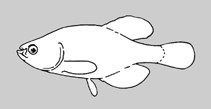
This species is distinguished from its congeners by having a unique colour pattern consisting of the following: mature males when alive with scattered small dark brown to grey irregular blotches on the laterodorsal surface of head and anterior portion of trunk, with many and relatively big sub-square irregular iridescent turquoise to light blue blotches on unpaired fins, evenly distributed, and those in the distal portion are elongated and merging, the trunk and tail with anterocentral part of scales iridescent turquoise with grey borders generating a reticulated pattern, the thin external border of the scales in the dorsal part of trunk, below the dorsal fin, are iridescent turquoise, and orange-yellowish background coloration on the base of unpaired fins and yellowish belly; in juveniles and young adults, anterior nostrils are ventrolaterally directed (Ref. 129129).
Body shape (shape guide): elongated; Cross section: compressed.
Found only in its type locality which is a seasonal pond, mainly covered with grass, in the Paraná Forest at ca.185 m a.s.l.. It is in an open space, in the surrounding jungle, with abundant palm trees. Maximum depth measured was ca. 80 cm, and the water was clear and no submerged aquatic vegetation was observed. The bottom is of soft sediment, with abundant organic
matter (Ref. 129129).
Vòng đời và hành vi giao phối
Chín muồi sinh dục | Sự tái sinh sản | Đẻ trứng | Các trứng | Sự sinh sản | Ấu trùng
Alonso, F., G.E. Terán, W.S. Serra Alanís, P. Calviño, M.M. Montes, I.D. García, J.A. Barneche, A. Almirón, L. Ciotek, P. Giorgis and J. Casciotta, 2023. From the mud to the tree: phylogeny of Austrolebias killifishes, new generic structure and description of a new species (Cyprinodontiformes: Rivulidae). Zool. J. Linn. Soc. 199:280-309. (Ref. 129129)
Tình trạng Sách đỏ IUCN (Ref. 130435: Version 2025-2 (Global))
Mối đe dọa đối với con người
Harmless
Sử dụng của con người
Các nghề cá: không ích lợi (thú vị)
Các công cụ
Báo cáo đặc biệt
Tải xuống XML
Các nguồn internet
Ước tính dựa trên mô hình
Chỉ số đa dạng phát sinh loài (Tài liệu tham khảo
82804): PD
50 = 0.5625 [Uniqueness, from 0.5 = low to 2.0 = high].
Bayesian length-weight: a=0.00617 (0.00266 - 0.01427), b=3.13 (2.93 - 3.33), in cm total length, based on LWR estimates for this (Sub)family-body shape (Ref.
93245).
Mức dinh dưỡng (Tài liệu tham khảo
69278): 3.2 ±0.4 se; based on size and trophs of closest relatives
Thích nghi nhanh (Tài liệu tham khảo
120179): Chiêù cao, thời gian nhân đôi của chủng quần tối thiểu là dưới 15 tháng (Preliminary K or Fecundity.).
Sự dễ bị tổn thương của nghề đánh cá (Ref.
59153): Low vulnerability (10 of 100).
🛈