Elasmobranchii (haaien en roggen) (sharks and rays) >
Squaliformes (Sleeper and dogfish sharks) >
Somniosidae (Sleeper sharks)
Etymology: Somniosus: Latin for sleepy, reflecting Lesueur’s surmise that these sharks are slow or sluggish because of their relatively small fins (hence the name sleeper sharks) (See ETYFish); rostratus: Latin for beaked, referring to its elongated rostrum (See ETYFish).
More on author: Risso.
Milieu: milieu / Klimaatzone / Diepte / verspreidingsgebied
Ecologie
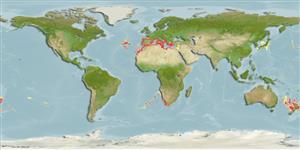
marien bathydemersaal; diepte 180 - 2734 m (Ref. 106604). Deep-water; 47°N - 43°S
Eastern Atlantic and the Mediterranean.
Lengte bij maturiteit / Grootte / Gewicht / Leeftijd
Maturiteit: Lm 108.0, range 82 - 134 cm
Max length : 143 cm TL mannelijk / geslacht onbekend; (Ref. 26346); common length : 100.0 cm TL mannelijk / geslacht onbekend; (Ref. )
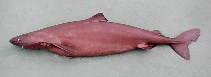
Dorsale stekels (totaal) : 0; Anale stekels: 0. Diagnosis: Somniosus rostratus is distinguished from S. longus in having overall length of second dorsal shorter than first dorsal fin 76-88% (vs. almost equal 91-100%); horizontal diameter of eye less than 37% (mean 33%) of length from snout tip to eye (vs. >37, mean 46%); number of tooth rows in upper jaw 53 (vs. 56-57); and spiral valve counts 23 (vs. 26-27) (Ref. 50224).
Body shape (shape guide): elongated.
A rare species (Ref. 26346) found on outer continental shelves and upper slopes (Ref. 247). Probably feeds on deepwater bottom fishes and invertebrates (Ref. 247). Ovoviviparous (Ref. 205), length at birth 21-28 cm TL (Ref. 26346). Utilized as fishmeal and possibly as food fish (Ref. 247).
Levenscyclus en paargedrag
Maturiteit | Voortplanting | Paaien | Eieren | Fecunditeit | Larven
Ovoviviparous (Ref. 247). Young born at 21-28 cm (Ref. 26346). Distinct pairing with embrace (Ref. 205).
Yano, K., J.D. Stevens and L.J.V. Compagno, 2004. A review of the systematics of the sleeper shark genus Somniosus with redescriptions of Somniosus (Somniosus) antarcticus and Somniosus (Rhinoscymnus) longus (Squaliformes: Somniosidae). Ichthyol. Res. 51:360-373. (Ref. 50224)
Status op de Rode Lijst van het IUCN (Ref. 130435: Version 2025-2 (Global))
Gevaar voor de mens
Harmless
Gebruik door de mens
Visserij: van minder commercieel belang
Tools
Speciale rapporten
Download XML
Internetbronnen
Schattingen op basis van modellen
Gewenste temperatuur (Ref.
123201): 8.6 - 14.2, mean 13.2 °C (based on 122 cells).
Fylogenetische diversiteitsindex (Ref.
82804): PD
50 = 0.5156 [Uniqueness, from 0.5 = low to 2.0 = high].
Bayesian length-weight: a=0.00398 (0.00172 - 0.00922), b=3.13 (2.94 - 3.32), in cm total length, based on LWR estimates for this (Sub)family-body shape (Ref.
93245).
Trofisch niveau (Ref.
69278): 4.2 ±0.4 se; based on diet studies.
Weerstandsvermogen (Ref.
120179): laag, minimale populatieverdubbelingstijd 4,5-14 jaar (Fec assumed to be <100).
Kwetsbaarheid van de visserij (Ref.
59153): Very high vulnerability (86 of 100).
🛈
Kwetsbaarheid voor het klimaat (Ref.
125649): Moderate vulnerability (39 of 100).
🛈
Voedingsstoffen (Ref.
124155): Calcium = 5.4 [1.0, 29.5] mg/100g; Iron = 0.286 [0.068, 0.948] mg/100g; Protein = 19.4 [17.1, 21.6] %; Omega3 = 0.269 [0.098, 0.861] g/100g; Selenium = 18.7 [5.6, 56.5] μg/100g; VitaminA = 11.3 [2.3, 57.4] μg/100g; Zinc = 0.292 [0.137, 0.565] mg/100g (wet weight);