Elasmobranquios (tiburones y rayas) (sharks and rays) >
Squaliformes (Sleeper and dogfish sharks) >
Somniosidae (Sleeper sharks)
Etymology: Somniosus: Latin for sleepy, reflecting Lesueur’s surmise that these sharks are slow or sluggish because of their relatively small fins (hence the name sleeper sharks) (See ETYFish); rostratus: Latin for beaked, referring to its elongated rostrum (See ETYFish).
More on author: Risso.
Entorno: milieu / zona climática / rango de profundidad / gama de distribución
Ecología
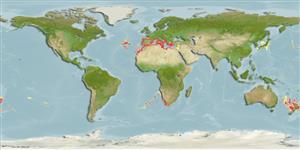
marino batidemersal; rango de profundidad 180 - 2734 m (Ref. 106604). Deep-water; 47°N - 43°S
Eastern Atlantic and the Mediterranean.
Longitud en la primera madurez / Tamaño / Peso / Edad
Madurez: Lm 108.0, range 82 - 134 cm
Max length : 143 cm TL macho / no sexado; (Ref. 26346); common length : 100.0 cm TL macho / no sexado; (Ref. )
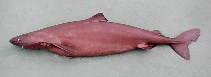
Espinas dorsales (total) : 0; Espinas anales: 0. Diagnosis: Somniosus rostratus is distinguished from S. longus in having overall length of second dorsal shorter than first dorsal fin 76-88% (vs. almost equal 91-100%); horizontal diameter of eye less than 37% (mean 33%) of length from snout tip to eye (vs. >37, mean 46%); number of tooth rows in upper jaw 53 (vs. 56-57); and spiral valve counts 23 (vs. 26-27) (Ref. 50224).
Body shape (shape guide): elongated.
A rare species (Ref. 26346) found on outer continental shelves and upper slopes (Ref. 247). Probably feeds on deepwater bottom fishes and invertebrates (Ref. 247). Ovoviviparous (Ref. 205), length at birth 21-28 cm TL (Ref. 26346). Utilized as fishmeal and possibly as food fish (Ref. 247).
Ciclo vital y comportamiento de apareamiento
Madurez | Reproducción | Puesta | Huevos | Fecundidad | Larva
Ovoviviparous (Ref. 247). Young born at 21-28 cm (Ref. 26346). Distinct pairing with embrace (Ref. 205).
Yano, K., J.D. Stevens and L.J.V. Compagno, 2004. A review of the systematics of the sleeper shark genus Somniosus with redescriptions of Somniosus (Somniosus) antarcticus and Somniosus (Rhinoscymnus) longus (Squaliformes: Somniosidae). Ichthyol. Res. 51:360-373. (Ref. 50224)
Situación en la Lista Roja de la UICN (Ref. 130435: Version 2025-2 (Global))
Amenaza para el ser humano
Harmless
Usos humanos
Pesquerías: escaso valor comercial
Herramientas
Informes especiales
Descargar XML
Fuentes de Internet
Estimaciones basadas en modelos
Temperatura preferida (Referencia
123201): 8.6 - 14.2, mean 13.2 °C (based on 122 cells).
Índice de diversidad filogenética (Referencia
82804): PD
50 = 0.5156 [Uniqueness, from 0.5 = low to 2.0 = high].
Bayesian length-weight: a=0.00398 (0.00172 - 0.00922), b=3.13 (2.94 - 3.32), in cm total length, based on LWR estimates for this (Sub)family-body shape (Ref.
93245).
Nivel trófico (Referencia
69278): 4.2 ±0.4 se; based on diet studies.
Resiliencia (Referencia
120179): Bajo, población duplicada en un tiempo mínimo de 4.5-14 años (Fec assumed to be <100).
Vulnerabilidad pesquera (Ref.
59153): Very high vulnerability (86 of 100).
🛈
Vulnerabilidad climática (Ref.
125649): Moderate vulnerability (39 of 100).
🛈
Nutrientes (Ref.
124155): Calcium = 5.4 [1.0, 29.5] mg/100g; Iron = 0.286 [0.068, 0.948] mg/100g; Protein = 19.4 [17.1, 21.6] %; Omega3 = 0.269 [0.098, 0.861] g/100g; Selenium = 18.7 [5.6, 56.5] μg/100g; VitaminA = 11.3 [2.3, 57.4] μg/100g; Zinc = 0.292 [0.137, 0.565] mg/100g (wet weight);