>
Perciformes/Serranoidei (Groupers) >
Anthiadidae (Fairy basslets or Streamer basses)
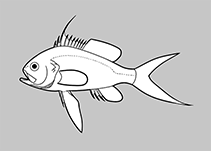
Etymology: Plectranthias: Bleeker (1873) disagrees with the generic placement of Plectropoma anthioides by Günther. He, therefore, erected Plectranthias to accommodate Pl. anthioides. The name is presumably the combination of the first part of Plectropoma (plectrum), and anthias. Plectrum = Plektron = πλῆκτρον (Greek, plektron = anyhting to strike with, spur + Greek, anthias = a fish, Ref. 45335); clavatus: Named 'clavatus', meaning 'club', referring to the stripe on the lateral surface of the body that defines the species.
was
collected from 100–386 m depth in Sagami Bay and the
Hachijo-jima Island, Izu Islands, Japan, and Guam (Fig.
5). In addition, an individual was observed at 406 m
depth on the Shoho Sea Mount, Nishi-Shichito Ridge,
southern Japan (Koeda et al., 2021b). All individuals
were collected from over rocky substrate.
Meio ambiente: milieu / Zona climática / intervalo de profundidade / faixa de distribuição
Ecologia
marinhas demersal; intervalo de profundidade 100 - 406 m (Ref. 132445). Tropical
West Pacific: Japan and Guam.
Tamanho / Peso / Idade
Maturidade: Lm ? range ? - ? cm
Max length : 20.0 cm SL macho/indeterminado; (Ref. 132445)
Descrição suscinta
Chaves de identificação | Morfologia | Morfometria
Espinhos dorsais (total) : 10; Raios dorsais (total) : 17 - 18; Espinhos anais: 3; Raios anais : 7; Vértebras: 26. This species is distinguished by the following set of characters: D X,17-18 (mode 17); pectoral-fin rays 13-14 (13), all are branched except for uppermost ray simple; principal caudal-fin rays 9 + 8; lateral line complete, pored scales 35-36 (35); scale rows above and below lateral line 5-5 and 16-17 (17), respectively; diagonal rows of large scales on cheek between eye and corner of preopercle 6-7 (6) ; circumpeduncular scales 15; rows of large predorsal scales ca. 8, single row of small scales extending to posterior two-thirds of interorbital area, tip not reaching line through posterior nostrils; body deep, depth at pelvic-fin origin 37.8-40.7 % (mean 39.1 %) of SL, greatest depth 39.6-42. 2 % (41.2 %) of SL; third dorsal-fin spine longest, its length 36.5-45.9 %
(41.9%) of body depth at pelvic-fin origin (BDP); anal-fin soft rays short, its longest ray length 47.9-59.1 % (53.5 %) of BDP; without scales on chin, branchiostegal membranes, infraorbital bones, maxilla, mandibles or snout; posterior margin of preopercle is serrated, ventral margin with 2 antrorse spines; short flaps at tips of second and third dorsal-fin spines. Colouration: three large orange-red saddles on dorsal edge of body; one orange-red stripe on posterior four-fifths of lateral body,saddles and stripe well-separated when fresh (Ref. 132445).
Cross section: compressed.
Collected over rocky substrate (Ref. 132445).
Ciclo de vida ou comportamento de acasalamento
Maturidade | Reprodução | Desova | Ovos | Fecundidade | Larvas
Wada, H. and H. Senou, 2024. Plectranthias clavatus a New Perchlet from Japan and Guam, with a Review of the Distributional Records of P. kamii (Perciformes: Serranidae: Anthiadinae). Bull. Kanagawa Pref. Mus. (Nat. Sci.), (53): 113-126. (Ref. 132445)
Status na Lista Vermelha da UICN (Ref. 130435: Version 2025-2 (Global))
Ameaça para os humanos
Harmless
Uso pelos humanos
Pescarias: sem interesse
Ferramentas
Relatórios especiais
Baixar XML
Fontes da internet
Estimativas baseadas em modelos
Índice de diversidade filogenética (Ref.
82804): PD
50 = 0.5000 [Uniqueness, from 0.5 = low to 2.0 = high].
Bayesian length-weight: a=0.02512 (0.00978 - 0.06451), b=2.98 (2.75 - 3.21), in cm total length, based on LWR estimates for this (Sub)family-body shape (Ref.
93245).
Nível Trófico (Ref.
69278): 4.0 ±0.7 se; based on size and trophs of closest relatives
Resiliência (Ref.
120179): médio(a), tempo mínimo de duplicação da população 1,4 - 4,4 anos (Preliminary K or Fecundity.).
Vulnerabilidade da pesca (Ref.
59153): Low vulnerability (14 of 100).
🛈