>
Beloniformes (Needle fishes) >
Adrianichthyidae (Ricefishes) > Oryziinae
Etymology: Oryzias: Greek, oryza = rice; because of the habitat used by this fish (Ref. 45335); loxolepis: Name from Ancient Greek ‘loxos’, meaning ‘oblique’ and ‘lepis’ meaning ‘scales’, referring to the diagonally aligned scales of this species.
Milieu: milieu / Klimaatzone / Diepte / verspreidingsgebied
Ecologie
; zoet water benthopelagisch; diepte 0 - 2 m (Ref. 133090). Tropical
Asia: Indonesia.
Grootte / Gewicht / Leeftijd
Maturiteit: Lm ? range ? - ? cm
Max length : 4.0 cm SL mannelijk / geslacht onbekend; (Ref. 133090); 3.5 cm SL (female)
Korte beschrijving
Determinatiesleutels | Morfologie | Morfometrie
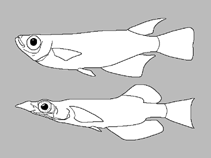
Dorsale zachte stralen (totaal) : 9 - 12; Anale zachte stralen: 22 - 27; Wervels: 27 - 29. This species is distinguished by the following characters: similar to Oryzias marmoratus by having dark brown blotches on a grayish-brown trunk, differs from O. marmoratus by having 11 abdominal vertebrae, 12 or 13 transverse scales, a shorter caudal peduncle, terminal mouth, reduced nuchal concavity, scales diagonally aligned aslant to midlateral stripe, and male with round-shaped dorsal fin without yellow margin; differs from O. profundicola (sympatric congener in Lake Towuti), in having a longer snout in both sexes, males with larger head and eyes, and a black margined dorsal fin, and females with shallower body depth at the anal- and dorsal-fin origins; D 9-12, A 22-27; head length 24.4-27.2% SL (male 24.4-26.2%, female 24.6-27.2%); eye diameter 10.8-12.5% SL; snout length 7.9-9.3% SL; body depth at point of anal-fin origin 26.1-30.7% SL (male 27.5-30.7%, female 26.1-28.5%); body depth at point of dorsal-fin origin 24.1–28.4%SL (male 25.0-28.4%m female 24.1-26.8%); caudal peduncle length 8.0-11.2% SL (Ref. 133090).
Cross section: oval.
ll specimens were collected and observed at daytime and this species occurs on gently sloping, shallow shores (1.5 m depth) with large boulders and submerged woods over sand and gravel. It often schools with O. profundicola and O. marmoratus and associated with Paratherina spp., Glossogobius sp., G. favipinnis, G. intermedius, Mugilogobius rexi, M. latifrons, and Nomorhamphus megarrhamphus (Ref. 133090).
Levenscyclus en paargedrag
Maturiteit | Voortplanting | Paaien | Eieren | Fecunditeit | Larven
Kobayashi, H., D.F. Mokodongan, M. Horoiwa, S. Fujimoto, R, Tanaka, K.W.A. Masengi and K. Yamahira, 2023. A new lacustrine ricefsh from central Sulawesi, with a redescription of Oryzias marmoratus (Teleostei: Adrianichthyidae). Ichthyol. Res. 70(4):490-514. (Ref. 133090)
Status op de Rode Lijst van het IUCN (Ref. 130435: Version 2025-2 (Global))
Gevaar voor de mens
Harmless
Gebruik door de mens
Visserij: van geen belang
Tools
Speciale rapporten
Download XML
Internetbronnen
Schattingen op basis van modellen
Fylogenetische diversiteitsindex (Ref.
82804): PD
50 = 0.5000 [Uniqueness, from 0.5 = low to 2.0 = high].
Bayesian length-weight: a=0.00479 (0.00190 - 0.01207), b=3.13 (2.91 - 3.35), in cm total length, based on LWR estimates for this (Sub)family-body shape (Ref.
93245).
Trofisch niveau (Ref.
69278): 3.4 ±0.4 se; based on size and trophs of closest relatives
Kwetsbaarheid van de visserij (Ref.
59153): Low vulnerability (10 of 100).
🛈