This website uses cookies to enhance your browsing experience and ensure the functionality of our site. For more detailed information about the types of cookies we use and how we protect your privacy, please visit our Privacy Information page.
×
Cookie Settings
This website uses different types of cookies to enhance your experience. Please select your preferences below:
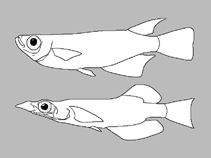
No image available for this species; drawing shows typical species in Adrianichthyidae.
分类 / 名称 俗名 | 同种异名 | Catalog of Fishes(属, 种) | ITIS | CoL | WoRMS | Cloffa
Teleostei > Beloniformes (Needle fishes) > Adrianichthyidae (Ricefishes) > Oryziinae
Etymology: Oryzias:Greek, oryza = rice; because of the habitat used by this fish (Ref. 45335); loxolepis:Name from Ancient Greek ‘loxos’, meaning ‘oblique’ and ‘lepis’ meaning ‘scales’, referring to the diagonally aligned scales of this species.
背的软条 (总数) : 9 - 12; 臀鳍软条: 22 - 27; 脊椎骨: 27 - 29. This species is distinguished by the following characters: similar to Oryzias marmoratus by having dark brown blotches on a grayish-brown trunk, differs from O. marmoratus by having 11 abdominal vertebrae, 12 or 13 transverse scales, a shorter caudal peduncle, terminal mouth, reduced nuchal concavity, scales diagonally aligned aslant to midlateral stripe, and male with round-shaped dorsal fin without yellow margin; differs from O. profundicola (sympatric congener in Lake Towuti), in having a longer snout in both sexes, males with larger head and eyes, and a black margined dorsal fin, and females with shallower body depth at the anal- and dorsal-fin origins; D 9-12, A 22-27; head length 24.4-27.2% SL (male 24.4-26.2%, female 24.6-27.2%); eye diameter 10.8-12.5% SL; snout length 7.9-9.3% SL; body depth at point of anal-fin origin 26.1-30.7% SL (male 27.5-30.7%, female 26.1-28.5%); body depth at point of dorsal-fin origin 24.1–28.4%SL (male 25.0-28.4%m female 24.1-26.8%); caudal peduncle length 8.0-11.2% SL (Ref. 133090). Cross section: oval.
ll specimens were collected and observed at daytime and this species occurs on gently sloping, shallow shores (1.5 m depth) with large boulders and submerged woods over sand and gravel. It often schools with O. profundicola and O. marmoratus and associated with Paratherina spp., Glossogobius sp., G. favipinnis, G. intermedius, Mugilogobius rexi, M. latifrons, and Nomorhamphus megarrhamphus (Ref. 133090).
Kobayashi, H., D.F. Mokodongan, M. Horoiwa, S. Fujimoto, R, Tanaka, K.W.A. Masengi and K. Yamahira, 2023. A new lacustrine ricefsh from central Sulawesi, with a redescription of Oryzias marmoratus (Teleostei: Adrianichthyidae). Ichthyol. Res. 70(4):490-514. (Ref. 133090)
世界自然保护联盟红皮书 (Ref. 130435: Version 2025-2 (Global))
系统发育多样性指数 (参考文献 82804): PD50 = 0.5000 [Uniqueness, from 0.5 = low to 2.0 = high].
Bayesian length-weight: a=0.00479 (0.00190 - 0.01207), b=3.13 (2.91 - 3.35), in cm total length, based on LWR estimates for this (Sub)family-body shape (Ref. 93245).
营养阶层 (参考文献 69278): 3.4 ±0.4 se; based on size and trophs of closest relatives
渔业脆弱性 (Ref. 59153): Low vulnerability (10 of 100). 🛈