Klassificering / Namn
Populärnamn | synonymer | Catalog of Fishes(Släkte, Arter) | ITIS | CoL | WoRMS | Cloffa
>
Gobiiformes (Gobies) >
Butidae (Gudgeon gobies)
Etymology: Ophiocara: Greek, ophis = serpent + Greek, kara = face (Ref. 45335).
Miljö: miljö / Klimatzon / djupintervall / distributionsområde
Ekologi
marina; sötvatten; brackvatten bottenlevande; amfidrom (Ref. 133165). Subtropical
Utbredning
Territorier | FAO områden | Ekosystem | Förekomster | Prickkarta | Utplanteringar | Faunafri
Indo-Pacific: Japan (Ryukyu Arch.), Taiwan, the Philippines, Palau, Cambodia, Thailand, Singapore, Malaysia, Indonesia, Australia, the Solomon Islands, and New Caledonia.
Storlek / Vikt / Ålder
Könsmognad: Lm ? range ? - ? cm
Max length : 19.3 cm SL hane/ej könsbestämd; (Ref. 133165); 17.6 cm SL (female)
Kort beskrivning
Bestämningsnycklar | Morfologi | Morfometri
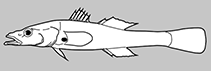
Taggstrålar i ryggfenan (totalt) : 7; Mjukstrålar i ryggfenan (totalt) : 8 - 9; Taggstrålar i analfenan: 1; Mjukstrålar i analfenan: 7; Ryggkotor: 26 - 27. This species is distinguished from its congeners by the following set of characters: longitudinal row scales 33-36; predorsal scales 20-26; snout length 9.4-11.5% of SL; upper jaw length 13.4-16.0% of SL; caudal fin length 27.3-34.6% of SL; opercular scales with ctenii; infraorbital neuromast rows from eye is usually six. Colouration: with conspicuous silver or white spots on head, body, and dorsal and caudal fins; while juveniles have two inverted triangular bands
on body; anterior of body with silver spots; caudal fin base no bright markings (Ref. 133165).
Body shape (shape guide): fusiform / normal; Cross section: oval.
Occurs mainly in the vegetation or under stones, roots or under leaf litter in the lower parts of rivers and ponds, from tidal influence to 15 m high in altitude, over sandy, muddy or gravel bottoms. It is a carnivorous fish that feeds on crustaceans, molluscs and fish (Ref. 126424). All specimens collected from Ryukyu Archipelago were caught in mangrove estuaries (Rhizophoraceae species dominant), in mainstream areas, channels, and pools near river mouths (salinity 14-30 ppt, 3 sites). Juveniles were usually in brackish pools with leaf litter on the muddy bottom. On Iriomote and Ishigaki islands, this species was usually observed with other gobioid species, including Acentrogobius janthinopterus, Bostrychus sinensis, Eleotris melanosoma and a Mugilogobius sp. (Ref. 133165).
Livscykel och parningsbeteende
Könsmognad | Reproduktion | Lek | Ägg | Fekunditet | Larver
Kobayashi, H. and M. Sato, 2023. The genus Ophiocara (Teleostei: Butidae) in Japan, with descriptions of two new species. Ichthyol. Res. 71(1):119-153. (Ref. 133165)
Status på IUCN:s rödlista (Ref. 130435: Version 2025-2 (Global))
Hot mot människor
Harmless
Mänskliga användningsområden
Fiskeri: saknar intresse
Verktyg
Särskilda rapporter
Ladda ner XML
Internet-källor
Uppskattningar baserade på modeller
Index för fylogenetisk mångfald (Ref.
82804): PD
50 = 0.5156 [Uniqueness, from 0.5 = low to 2.0 = high].
Bayesian length-weight: a=0.00741 (0.00377 - 0.01459), b=3.00 (2.82 - 3.18), in cm total length, based on LWR estimates for this species & (Sub)family-body (Ref.
93245).
Trofisk nivå (Ref.
69278): 3.3 ±0.55 se; based on food items.
Resiliens (Ref.
120179): Hög, lägsta populationsfördubblingstid mindre än 15 månader (Preliminary K or Fecundity.).
Sårbarhet i fisket (Ref.
59153): Low vulnerability (14 of 100).
🛈