>
Gobiiformes (Gobies) >
Butidae (Gudgeon gobies)
Etymology: Ophiocara: Greek, ophis = serpent + Greek, kara = face (Ref. 45335).
Môi trường: môi trường / vùng khí hậu / Mức độ sâu / phạm vi phân phối
Sinh thái học
biển; nước ngọt; thuộc về nước lợ gần đáy; sống cả ở nước ngọt và nuớc mặn (Ref. 133165). Subtropical
Sự phân bố
Lãnh thổ | Các khu vực của FAO | Các hệ sinh thái | Những lần xuất hiện | Bản đồ điểm | Những chỉ dẫn | Faunafri
Indo-Pacific: Japan (Ryukyu Arch.), Taiwan, the Philippines, Palau, Cambodia, Thailand, Singapore, Malaysia, Indonesia, Australia, the Solomon Islands, and New Caledonia.
Bộ gần gũi / Khối lượng (Trọng lượng) / Tuổi
Chín muồi sinh dục: Lm ? range ? - ? cm
Max length : 19.3 cm SL con đực/không giới tính; (Ref. 133165); 17.6 cm SL (female)
Mô tả ngắn gọn
Khóa để định loại | Hình thái học | Sinh trắc học
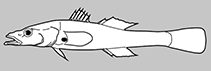
Các tia vây lưng cứng (tổng cộng) : 7; Các vây lưng mềm (tổng cộng) : 8 - 9; Tia cứng vây hậu môn: 1; Tia mềm vây hậu môn: 7; Động vật có xương sống: 26 - 27. This species is distinguished from its congeners by the following set of characters: longitudinal row scales 33-36; predorsal scales 20-26; snout length 9.4-11.5% of SL; upper jaw length 13.4-16.0% of SL; caudal fin length 27.3-34.6% of SL; opercular scales with ctenii; infraorbital neuromast rows from eye is usually six. Colouration: with conspicuous silver or white spots on head, body, and dorsal and caudal fins; while juveniles have two inverted triangular bands
on body; anterior of body with silver spots; caudal fin base no bright markings (Ref. 133165).
Body shape (shape guide): fusiform / normal; Cross section: oval.
Occurs mainly in the vegetation or under stones, roots or under leaf litter in the lower parts of rivers and ponds, from tidal influence to 15 m high in altitude, over sandy, muddy or gravel bottoms. It is a carnivorous fish that feeds on crustaceans, molluscs and fish (Ref. 126424). All specimens collected from Ryukyu Archipelago were caught in mangrove estuaries (Rhizophoraceae species dominant), in mainstream areas, channels, and pools near river mouths (salinity 14-30 ppt, 3 sites). Juveniles were usually in brackish pools with leaf litter on the muddy bottom. On Iriomote and Ishigaki islands, this species was usually observed with other gobioid species, including Acentrogobius janthinopterus, Bostrychus sinensis, Eleotris melanosoma and a Mugilogobius sp. (Ref. 133165).
Vòng đời và hành vi giao phối
Chín muồi sinh dục | Sự tái sinh sản | Đẻ trứng | Các trứng | Sự sinh sản | Ấu trùng
Kobayashi, H. and M. Sato, 2023. The genus Ophiocara (Teleostei: Butidae) in Japan, with descriptions of two new species. Ichthyol. Res. 71(1):119-153. (Ref. 133165)
Tình trạng Sách đỏ IUCN (Ref. 130435: Version 2025-2 (Global))
Mối đe dọa đối với con người
Harmless
Sử dụng của con người
Các nghề cá: không ích lợi (thú vị)
Các công cụ
Báo cáo đặc biệt
Tải xuống XML
Các nguồn internet
Ước tính dựa trên mô hình
Chỉ số đa dạng phát sinh loài (Tài liệu tham khảo
82804): PD
50 = 0.5156 [Uniqueness, from 0.5 = low to 2.0 = high].
Bayesian length-weight: a=0.00741 (0.00377 - 0.01459), b=3.00 (2.82 - 3.18), in cm total length, based on LWR estimates for this species & (Sub)family-body (Ref.
93245).
Mức dinh dưỡng (Tài liệu tham khảo
69278): 3.3 ±0.55 se; based on food items.
Thích nghi nhanh (Tài liệu tham khảo
120179): Chiêù cao, thời gian nhân đôi của chủng quần tối thiểu là dưới 15 tháng (Preliminary K or Fecundity.).
Sự dễ bị tổn thương của nghề đánh cá (Ref.
59153): Low vulnerability (14 of 100).
🛈