Classification / Noms
Noms communs | Synonymes | Catalog of Fishes(Genre, Espèce) | ITIS | CoL | WoRMS | Cloffa
>
Siluriformes (Catfishes) >
Trichomycteridae (Pencil or parasitic catfishes) > Trichomycterinae
Etymology: Cambeva: Probably derived from the Tupi-Guarani, is a popular name for trichomycterid fishes in southern and south-eastern Brazil (Ref. 119381); atrobrunnea: Name 'atrobrunnea' from the Latin word 'ater' and 'brunneus', meaning 'dull black,dark' and 'brown', in reference to predominant colour of the flank in adult specimens of the new species.
Environnement : milieu / zone climatique / profondeur / gamme de distribution
Écologie
; eau douce démersal. Subtropical
South America: Brazil.
Taille / Poids / Âge
Maturité: Lm ? range ? - ? cm
Max length : 7.0 cm SL mâle / non sexé; (Ref. 137708)
Description synthétique
Clés d'identification | Morphologie | Morphométrie
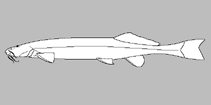
Épines dorsales (Total) : 2 - 3; Rayons mous dorsaux (Total) : 6 - 7; Épines anales: 2; Rayons mous anaux: 5 - 6; Vertèbres: 39 - 40. This species is distinguished from its congeners by the following set of characters: two posterior-most dorsal and ventral procurrent caudal-fin rays segmented; subtruncate caudal fin; interopercular odontodes 20-22; specimens below about 40 mm SL having flank light grey with small black dots that are arranged in irregular rows, coalesced on the anterior portion of the longitudinal midline to form a stripe; nasal barbel reaching area just anterior to opercle; ventral procurrent caudal-fin rays 13 or 14; jaw teeth irregularly arranged procurrent caudal-fin rays 21 dorsal and 13 or 14 ventral; opercular odontodes 12; pectoral-fin rays 7; anterior infraorbital absent; posterior margin of the caudal fin slightly convex; hypertrophied papillae on the ventral surface of the head absent; pectoral-fin filament absent; opercular odontodes 12; interopercular odontodes 20-22; dorsal procurrent caudal-fin rays 21; ventral procurrent caudal-fin rays 13 or 14; dorsal-fin origin at a vertical through the centrum of the 21st or 22nd vertebra; jaw teeth pointed, irregularly arranged; vertebrae 39 or 40 (Ref. 137708).
Body shape (shape guide): elongated; Cross section: oval.
Cycle de vie et comportement reproducteur
Maturité | Reproduction | Frai | Œufs | Fécondité | Larves
Costa, W.J.E.M., C.R.M Feltrin, J.L.O Mattos and A.M. Katz, 2024. Top mountain areas of subtropical southern Brazil sheltering four new small-ranged catfishes (Siluriformes, Trichomycteridae): relationships and taxonomy. Evolutionary Systematics. 8:199-218. (Ref. 137708)
Statut dans la liste rouge de l'IUCN (Ref. 130435: Version 2025-2 (Global))
Menace pour l'homme
Harmless
Utilisations par l'homme
Pêcheries: sans intérêt
Outils
Articles particuliers
Télécharger en XML
Sources Internet
Estimations basées sur des modèles
Indice de diversité phylogénétique (Réf.
82804): PD
50 = 0.5000 [Uniqueness, from 0.5 = low to 2.0 = high].
Bayesian length-weight: a=0.00759 (0.00337 - 0.01709), b=3.00 (2.81 - 3.19), in cm total length, based on LWR estimates for this (Sub)family-body shape (Ref.
93245).
Niveau trophique (Réf.
69278): 3.2 ±0.4 se; based on size and trophs of closest relatives
Vulnérabilité de la pêche (Ref.
59153): Low vulnerability (10 of 100).
🛈