Klassifizierung / Names
Namen | Synonyme | Catalog of Fishes(Gattung, Arten) | ITIS | CoL | WoRMS | Cloffa
>
Siluriformes (Catfishes) >
Trichomycteridae (Pencil or parasitic catfishes) > Trichomycterinae
Etymology: Cambeva: Probably derived from the Tupi-Guarani, is a popular name for trichomycterid fishes in southern and south-eastern Brazil (Ref. 119381); atrobrunnea: Name 'atrobrunnea' from the Latin word 'ater' and 'brunneus', meaning 'dull black,dark' and 'brown', in reference to predominant colour of the flank in adult specimens of the new species.
Umwelt: Milieu / Klimazone / Tiefenbereich / Verbreitungsgebiet
Ökologie
; süßwasser demersal. Subtropical
South America: Brazil.
Größe / Gewicht / Alter
Geschlechtsreife: Lm ? range ? - ? cm
Max length : 7.0 cm SL Männchen/unbestimmt; (Ref. 137708)
Kurzbeschreibung
Bestimmungsschlüssel | Morphologie | Morphometrie
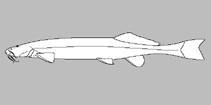
Rückenflossenstacheln (insgesamt) : 2 - 3; Rückenflossenweichstrahlen (insgesamt) : 6 - 7; Afterflossenstacheln: 2; Afterflossenweichstrahlen: 5 - 6; Wirbelzahl: 39 - 40. This species is distinguished from its congeners by the following set of characters: two posterior-most dorsal and ventral procurrent caudal-fin rays segmented; subtruncate caudal fin; interopercular odontodes 20-22; specimens below about 40 mm SL having flank light grey with small black dots that are arranged in irregular rows, coalesced on the anterior portion of the longitudinal midline to form a stripe; nasal barbel reaching area just anterior to opercle; ventral procurrent caudal-fin rays 13 or 14; jaw teeth irregularly arranged procurrent caudal-fin rays 21 dorsal and 13 or 14 ventral; opercular odontodes 12; pectoral-fin rays 7; anterior infraorbital absent; posterior margin of the caudal fin slightly convex; hypertrophied papillae on the ventral surface of the head absent; pectoral-fin filament absent; opercular odontodes 12; interopercular odontodes 20-22; dorsal procurrent caudal-fin rays 21; ventral procurrent caudal-fin rays 13 or 14; dorsal-fin origin at a vertical through the centrum of the 21st or 22nd vertebra; jaw teeth pointed, irregularly arranged; vertebrae 39 or 40 (Ref. 137708).
Body shape (shape guide): elongated; Cross section: oval.
Lebenszyklus und Paarungsverhalten
Geschlechtsreife | Fortpflanzung | Ablaichen | Eier | Fruchtbarkeit | Larven
Costa, W.J.E.M., C.R.M Feltrin, J.L.O Mattos and A.M. Katz, 2024. Top mountain areas of subtropical southern Brazil sheltering four new small-ranged catfishes (Siluriformes, Trichomycteridae): relationships and taxonomy. Evolutionary Systematics. 8:199-218. (Ref. 137708)
IUCN Rote Liste Status (Ref. 130435: Version 2025-2 (Global))
Bedrohung für Menschen
Harmless
Nutzung durch Menschen
Fischereien: nicht kommerziell
Tools
Zusatzinformationen
Download XML
Internet Quellen
Schätzungen auf der Grundlage von Modellen
Phylogenetischer Diversitätsindex (Ref.
82804): PD
50 = 0.5000 [Uniqueness, from 0.5 = low to 2.0 = high].
Bayesian length-weight: a=0.00759 (0.00337 - 0.01709), b=3.00 (2.81 - 3.19), in cm total length, based on LWR estimates for this (Sub)family-body shape (Ref.
93245).
Trophische Ebene (Ref.
69278): 3.2 ±0.4 se; based on size and trophs of closest relatives
Anfälligkeit der Fischerei (Ref.
59153): Low vulnerability (10 of 100).
🛈