>
Gobiiformes (Gobies) >
Gobiidae (Gobies) > Gobiinae
Etymology: Eviota: No etymology given, suggested by Christopher Scharpt: from Latin 'eu' for 'true' and 'iota' for anything very small, in combination 'truly very small' referring to it as being the smallest vertebrate at the time it has benn described by Jenkins (thus, making the suggestion by Scharpt plausible.
Eponymy: Lieutenant-Colonel Philip Frederik Lambertus Christiaan Lach de Bère (1859–1936) of the Royal Netherlands East Indies Army was born in Sumatra and lived in Indonesia, where this goby was collected. [...] (Ref. 128868), visit book page.
Ambiente: milieu / zona climatica / distribuzione batimetrica / gamma di distribuzione
Ecologia
marino associati a barriera corallina; distribuzione batimetrica 3 - 20 m (Ref. 90102). Tropical; 8°N - 18°S
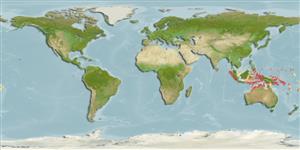
Western Pacific: Japan, Palau, Federated States of Micronesia, Guam and Northern Mariana Islands, Vietnam, Indonesia; south to Rowley Shoals in the Timor Sea, Papua New Guinea, and Solomon Islands.
Dimensione / Peso / Età
Maturità: Lm ? range ? - ? cm
Max length : 2.1 cm SL maschio/sesso non determinato; (Ref. 1602)
Breve descrizione
Chiavi di identificazione | Morfologia | Morfometria
Spine dorsali (totale) : 7; Raggi dorsali molli (totale) : 7 - 9; Spine anali: 1; Raggi anali molli: 6 - 7. Characterized by dark purplish brown body color with three white spots anteriorly on middle of side; presence of series of small white spots beginning on nape, continuing along base of dorsal fin and ending on dorsal surface of caudal peduncle; caudal fin base with red-edged black spot; iris reddish; first four dorsal spines elongate or filamentous in male; all pectoral rays unbranched; longitudinal scale series 21-23; ctenoid scales, absent on head, nape and pectoral fin base; separated pelvic fins, thin membrane joining bases; well developed fifth pelvic ray, 50-70% length of fourth ray; 3-6 branches of fourth pelvic ray; depth of body 3.6-5.0 in SL (Ref. 90102).
Body shape (shape guide): elongated; Cross section: oval.
Inhabits silty sheltered reefs (Ref. 1602). Reported to be associated with the mushroom Heliofungia actiniformis (Ref. 91291).
Ciclo vitale e comportamento di accoppiamento
Maturità | Riproduzione | Deposizione | Uova | Fecondità | Larve
Myers, R.F., 1991. Micronesian reef fishes. Second Ed. Coral Graphics, Barrigada, Guam. 298 p. (Ref. 1602)
Stato della Lista Rossa IUCN (Ref. 130435: Version 2025-2 (Global))
Minaccia per l'uomo
Harmless
Usi umani
Strumenti
Rapporti speciali
Scarica XML
Fonti Internet
Stime basate su modelli
Temperatura preferita (Fonte Biblio.
123201): 27.6 - 29.4, mean 28.8 °C (based on 934 cells).
Indice di diversità filogenetica (Fonte Biblio.
82804): PD
50 = 0.5000 [Uniqueness, from 0.5 = low to 2.0 = high].
Bayesian length-weight: a=0.00692 (0.00281 - 0.01706), b=3.09 (2.92 - 3.26), in cm total length, based on LWR estimates for this Genus-body shape (Ref.
93245).
Livello trofico (Fonte Biblio.
69278): 3.1 ±0.3 se; based on size and trophs of closest relatives
Resilienza (Fonte Biblio.
120179): Alto, tempo minimo di raddoppiamento della popolazione meno di 15 mesi (Preliminary K or Fecundity.).
Vulnerabilità della pesca (Ref.
59153): Low vulnerability (10 of 100).
🛈
Nutrienti (Ref.
124155): Calcium = 472 [191, 1,637] mg/100g; Iron = 1.78 [0.71, 4.27] mg/100g; Protein = 17.5 [15.4, 19.5] %; Omega3 = 0.102 [0.030, 0.331] g/100g; Selenium = 35.4 [8.8, 118.5] μg/100g; VitaminA = 112 [19, 638] μg/100g; Zinc = 5.24 [2.67, 9.17] mg/100g (wet weight);