>
Gobiiformes (Gobies) >
Gobiidae (Gobies) > Gobiinae
Etymology: Eviota: No etymology given, suggested by Christopher Scharpt: from Latin 'eu' for 'true' and 'iota' for anything very small, in combination 'truly very small' referring to it as being the smallest vertebrate at the time it has benn described by Jenkins (thus, making the suggestion by Scharpt plausible.
Eponymy: Lieutenant-Colonel Philip Frederik Lambertus Christiaan Lach de Bère (1859–1936) of the Royal Netherlands East Indies Army was born in Sumatra and lived in Indonesia, where this goby was collected. [...] (Ref. 128868), visit book page.
Окружающая среда: среда / климатическая зона / пределы глубины / диапазон распространения
экология
морской ассоциированный с рифами; пределы глубины 3 - 20 m (Ref. 90102). Tropical; 8°N - 18°S
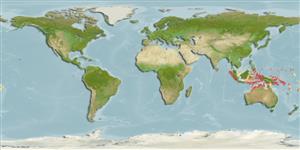
Western Pacific: Japan, Palau, Federated States of Micronesia, Guam and Northern Mariana Islands, Vietnam, Indonesia; south to Rowley Shoals in the Timor Sea, Papua New Guinea, and Solomon Islands.
Размер / Вес / Возраст
половая зрелость: Lm ? range ? - ? cm
Max length : 2.1 cm SL самец/пол неопределен; (Ref. 1602)
Краткое описание
определительные ключи | морфология | морфометрия
колючие лучи спинного плавника (общее число) : 7; членистые (мягкие) лучи спинного плавника (общее число) : 7 - 9; колючие лучи анального плавника: 1; членистые (мягкие) лучи анального плавника: 6 - 7. Characterized by dark purplish brown body color with three white spots anteriorly on middle of side; presence of series of small white spots beginning on nape, continuing along base of dorsal fin and ending on dorsal surface of caudal peduncle; caudal fin base with red-edged black spot; iris reddish; first four dorsal spines elongate or filamentous in male; all pectoral rays unbranched; longitudinal scale series 21-23; ctenoid scales, absent on head, nape and pectoral fin base; separated pelvic fins, thin membrane joining bases; well developed fifth pelvic ray, 50-70% length of fourth ray; 3-6 branches of fourth pelvic ray; depth of body 3.6-5.0 in SL (Ref. 90102).
Body shape (shape guide): elongated; Cross section: oval.
Inhabits silty sheltered reefs (Ref. 1602). Reported to be associated with the mushroom Heliofungia actiniformis (Ref. 91291).
Жизненный цикл и брачное поведение
половая зрелость | размножение | нерест | икра | Плодовитость | личинки
Myers, R.F., 1991. Micronesian reef fishes. Second Ed. Coral Graphics, Barrigada, Guam. 298 p. (Ref. 1602)
Статус Красного Списка МСОП (Ref. 130435: Version 2025-2 (Global))
Угроза для людей
Harmless
Использование человеком
дополнительная информация
инструменты
Специальные отчеты
Скачать в формате XML
ресурсы в Интернет
Оценки, основанные на моделях
Предпочтительная температура (ссылка
123201): 27.6 - 29.4, mean 28.8 °C (based on 934 cells).
Индекс филогенетического разнообразия (ссылка
82804): PD
50 = 0.5000 [Uniqueness, from 0.5 = low to 2.0 = high].
Bayesian length-weight: a=0.00692 (0.00281 - 0.01706), b=3.09 (2.92 - 3.26), in cm total length, based on LWR estimates for this Genus-body shape (Ref.
93245).
Трофический уровень (ссылка
69278): 3.1 ±0.3 se; based on size and trophs of closest relatives
устойчивость к внешним воздействиям (ссылка
120179): высокий, минимальное время удвоения популяции до 15 месяцев (Preliminary K or Fecundity.).
Уязвимость рыбной ловли (Ref.
59153): Low vulnerability (10 of 100).
🛈
Питательные вещества (Ref.
124155): Calcium = 472 [191, 1,637] mg/100g; Iron = 1.78 [0.71, 4.27] mg/100g; Protein = 17.5 [15.4, 19.5] %; Omega3 = 0.102 [0.030, 0.331] g/100g; Selenium = 35.4 [8.8, 118.5] μg/100g; VitaminA = 112 [19, 638] μg/100g; Zinc = 5.24 [2.67, 9.17] mg/100g (wet weight);