Elasmobranchii (tubarões e raias) (sharks and rays) >
Squatiniformes (Angel sharks) >
Squatinidae (Angel sharks)
Etymology: Squatina: Latin for skate, which angel sharks superficially resemble, presumably tautonymous with Squalus squatina Linnaeus 1758 (no species mentioned) (See ETYFish); japonica: -ica (L.), belonging to: Japan, referring to Nagasaki, type locality (See ETYFish).
More on author: Bleeker.
Meio ambiente: milieu / Zona climática / intervalo de profundidade / faixa de distribuição
Ecologia
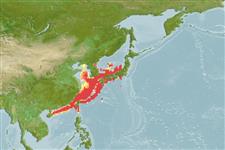
marinhas demersal. Subtropical; 41°N - 19°N, 111°E - 139°E (Ref. 54906)
Northwest Pacific: Japan, Yellow Sea, Korea, and northern China.
Tamanho / Peso / Idade
Maturidade: Lm ? range ? - ? cm
Max length : 200 cm TL macho/indeterminado; (Ref. 247)
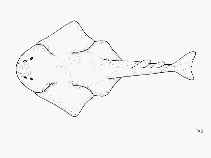
Espinhos dorsais (total) : 0; Espinhos anais: 0. Japanese angelshark Squatina japonica has broad pectoral fins with rounded free rear tips, posterior margin nearly straight, inner margin strongly convex; nasal barbels simple and spatulate. Anterior nasal flaps smooth to weakly fringed; dermal folds on sides of head without lobes. Rear tip of inner margin of pelvic fins considerably anterior to origin of first dorsal; very short hypocercal tail. Rows of moderately large spines on midline of back and tail from head to dorsal fins and between fin bases, and on snout and above eyes. Body color blackish brown with small dark and pale spots; no ocelli (eye-like spot) (Ref. 247, 31369, 12951).
Body shape (shape guide): other.
A little-known angelshark, found on or near the bottom (Ref. 247). Lives in sandy ground. A carnivore that eats benthic animals (Ref. 9137). Ovoviviparous (Ref. 50449). Utilized for human consumption and for preparation of shagreen (Ref. 247).
Ciclo de vida ou comportamento de acasalamento
Maturidade | Reprodução | Desova | Ovos | Fecundidade | Larvas
Ovoviviparous, embryos feed solely on yolk (Ref. 50449).
Compagno, L.J.V., 1984. FAO Species Catalogue. Vol. 4. Sharks of the world. An annotated and illustrated catalogue of shark species known to date. Part 1 - Hexanchiformes to Lamniformes. FAO Fish. Synop. 125(4/1):1-249. Rome, FAO. (Ref. 247)
Status na Lista Vermelha da UICN (Ref. 130435: Version 2025-2 (Global))
Ameaça para os humanos
Traumatogenic
Uso pelos humanos
Pescarias: pouco comercial
Ferramentas
Relatórios especiais
Baixar XML
Fontes da internet
Estimativas baseadas em modelos
Temperatura preferida (Ref.
123201): 5.7 - 20.7, mean 17.3 °C (based on 123 cells).
Índice de diversidade filogenética (Ref.
82804): PD
50 = 0.5000 [Uniqueness, from 0.5 = low to 2.0 = high].
Bayesian length-weight: a=0.00661 (0.00287 - 0.01523), b=3.07 (2.88 - 3.26), in cm total length, based on LWR estimates for this Genus-body shape (Ref.
93245).
Nível Trófico (Ref.
69278): 3.5 ±0.37 se; based on food items.
Resiliência (Ref.
120179): Baixo, tempo mínimo de duplicação da população 4,5 - 14 anos (Fec assumed to be <100).
Vulnerabilidade da pesca (Ref.
59153): Very high vulnerability (90 of 100).
🛈