Elasmobranchii (Haie und Rochen) (sharks and rays) >
Squatiniformes (Angel sharks) >
Squatinidae (Angel sharks)
Etymology: Squatina: Latin for skate, which angel sharks superficially resemble, presumably tautonymous with Squalus squatina Linnaeus 1758 (no species mentioned) (See ETYFish); oculata: Latin for eyed or having eyes, referring to the symmetrical ocelli seen on some specimens (See ETYFish).
More on author: Bonaparte.
Umwelt: Milieu / Klimazone / Tiefenbereich / Verbreitungsgebiet
Ökologie
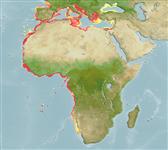
seewasser demersal; tiefenbereich 5 - 500 m (Ref. 10719), usually 50 - 100 m (Ref. 247). Subtropical; 47°N - 29°S, 17°W - 37°E
Eastern Atlantic: Mediterranean and Morocco to Angola.
Größe / Gewicht / Alter
Geschlechtsreife: Lm ? range ? - ? cm
Max length : 160 cm TL Männchen/unbestimmt; (Ref. 247); common length : 120 cm TL Männchen/unbestimmt; (Ref. )
Kurzbeschreibung
Bestimmungsschlüssel | Morphologie | Morphometrie
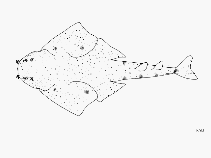
Rückenflossenstacheln (insgesamt) : 0. An angelshark with large thorns on snout and above eyes but not on midback, weakly bifurcated nasal barbels and weakly fringed anterior nasal flaps, the first dorsal-fin origin usually well behind the rear tips of pelvic fin, and prominent white spots on body (Ref. 247)
Body shape (shape guide): other; Cross section: flattened.
Found on sand and mud bottom (Ref. 26999) of continental shelves and upper slopes (Ref. 247). Mostly between 50 and 100 m but deeper in the tropics (Ref. 247). Feeds on small fishes (Ref. 247). Ovoviviparous (Ref. 50449). Utilized fresh and dried salted for human consumption; liver oil and hide also used (Ref. 247).
Lebenszyklus und Paarungsverhalten
Geschlechtsreife | Fortpflanzung | Ablaichen | Eier | Fruchtbarkeit | Larven
Ovoviviparous, embryos feed solely on yolk (Ref. 50449). Size at birth about 24 to 27 cm TL (Ref. 247).
Compagno, L.J.V., 1984. FAO Species Catalogue. Vol. 4. Sharks of the world. An annotated and illustrated catalogue of shark species known to date. Part 1 - Hexanchiformes to Lamniformes. FAO Fish. Synop. 125(4/1):1-249. Rome, FAO. (Ref. 247)
IUCN Rote Liste Status (Ref. 130435: Version 2025-2 (Global))
Bedrohung für Menschen
Traumatogenic
Nutzung durch Menschen
Fischereien: weniger kommerziell
Tools
Zusatzinformationen
Download XML
Internet Quellen
Schätzungen auf der Grundlage von Modellen
Bevorzugte Temperatur (Ref.
123201): 13 - 19.3, mean 15.3 °C (based on 133 cells).
Phylogenetischer Diversitätsindex (Ref.
82804): PD
50 = 0.5000 [Uniqueness, from 0.5 = low to 2.0 = high].
Bayesian length-weight: a=0.00550 (0.00300 - 0.01006), b=3.06 (2.90 - 3.22), in cm total length, based on LWR estimates for this species & Genus-body shape (Ref.
93245).
Trophische Ebene (Ref.
69278): 4.0 ±0.5 se; based on diet studies.
Widerstandsfähigkeit (Ref.
120179): niedrig, Verdopplung der Population dauert 4,5 - 14 Jahre. (Fec assumed to be <100).
Anfälligkeit der Fischerei (Ref.
59153): Very high vulnerability (90 of 100).
🛈
Nährstoffe (Ref.
124155): Calcium = 16.4 [3.7, 79.5] mg/100g; Iron = 0.706 [0.185, 2.111] mg/100g; Protein = 19.2 [17.1, 21.1] %; Omega3 = 0.237 [0.112, 0.507] g/100g; Selenium = 36 [11, 102] μg/100g; VitaminA = 9.75 [3.35, 29.81] μg/100g; Zinc = 0.442 [0.216, 0.817] mg/100g (wet weight);