>
Anguilliformes (Eels and morays) >
Anguillidae (Freshwater eels)
Etymology: Anguilla: Latin, anguilla, .-ae = eel (Ref. 45335).
Eponymy: Dr Johannes Theodor Reinhardt (1816–1882) was a Danish zoologist who was Director of the National Natural History Museum, Copenhagen. [...] (Ref. 128868), visit book page.
More on author: Steindachner.
Environnement : milieu / zone climatique / profondeur / gamme de distribution
Écologie
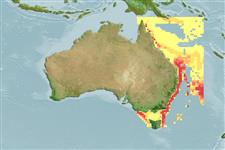
marin; eau douce; saumâtre démersal; catadrome (Ref. 138138); profondeur 0 - 3000 m (Ref. 86942). Tropical; 10°S - 43°S, 141°E - 161°E (Ref. 57367)
Asia and Oceania: New Guinea, eastern Australia, including Tasmania, Lord Howe Island and New Caledonia.
Taille / Poids / Âge
Maturité: Lm ? range ? - ? cm
Max length : 165 cm TL mâle / non sexé; (Ref. 82796); 158.0 cm TL (female); common length : 100.0 cm TL mâle / non sexé; (Ref. 5259); poids max. publié: 22.0 kg (Ref. 82796); âge max. reporté: 41 années (Ref. 6390)
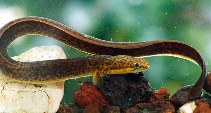
Characterized by mottled color and tooth bands with a separated inner series. The only other species within its range with these characters is Anguilla marmorata, but that species has a longer dorsal fin (Ref. 9828).
Body shape (shape guide): eel-like.
Adults occur in coastal lagoons, rivers, streams, lakes, swamps and farm dams, but prefer riverine habitats (Ref. 26509, 44894). Usually found in deep waters of reservoirs well away from the shore. Mature adults undertake annual spawning migrations to oceanic waters (Ref. 44894). Mainly nocturnal feeders. They feed on crustaceans, mollusks, aquatic and terrestrial insects, fish including elvers and native trout. Maximum size for female longfin eel taken from Ref. 6390. A reasonably good angling fish which may grow to 22 kilograms (Ref. 44894).
Cycle de vie et comportement reproducteur
Maturité | Reproduction | Frai | Œufs | Fécondité | Larves
Allen, G.R., 1989. Freshwater fishes of Australia. T.F.H. Publications, Inc., Neptune City, New Jersey. (Ref. 5259)
Statut dans la liste rouge de l'IUCN (Ref. 130435: Version 2025-2 (Global))
Menace pour l'homme
Harmless
Utilisations par l'homme
Pêcheries: commercial; Aquaculture: commercial; pêche sportive: oui
Outils
Articles particuliers
Télécharger en XML
Sources Internet
Estimations basées sur des modèles
Température préférée (Réf.
123201): 3.8 - 12.7, mean 5.5 °C (based on 94 cells).
Indice de diversité phylogénétique (Réf.
82804): PD
50 = 0.5000 [Uniqueness, from 0.5 = low to 2.0 = high].
Bayesian length-weight: a=0.00076 (0.00037 - 0.00155), b=3.17 (3.00 - 3.34), in cm total length, based on LWR estimates for this Genus-body shape (Ref.
93245).
Niveau trophique (Réf.
69278): 3.6 ±0.56 se; based on food items.
Résilience (Réf.
120179): Très faible, temps minimum de doublement de population supérieur à 14 ans (tm=8-30; tmax=41, Fec=5 million).
Vulnérabilité de la pêche (Ref.
59153): Very high vulnerability (90 of 100).
🛈