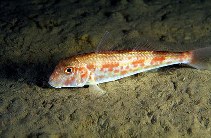
Taxonomic Remarks
Mullus barbatus barbatus Linnaeus, 1758 and Mullus barbatus ponticus Essipov, 1927 (restricted to Black and Azov Seas) are constantly recognized as subspecies rank, including in Eschmeyer's CofF (ver. Nov. 2020). Related information is found under the "Stocks" link in the species summary page / More info.
Umwelt: Milieu / Klimazone / Tiefenbereich / Verbreitungsgebiet
Ökologie
seewasser demersal; tiefenbereich 10 - 328 m (Ref. 56504), usually 100 - 300 m (Ref. 35388). Subtropical; 58°N - 14°N, 32°W - 42°E
Eastern Atlantic: Norway, British Isles (occasionally Scandinavia) to Dakar, Senegal, Canary Islands, Mediterranean, including Azores and Madeira.
Länge bei der ersten Reifung / Größe / Gewicht / Alter
Geschlechtsreife: Lm 11.5, range 10 - ? cm
Max length : 38.2 cm TL Männchen/unbestimmt; (Ref. 88921); common length : 20.0 cm SL Männchen/unbestimmt; (Ref. 4845); max. veröff. Gewicht: 680.00 g (Ref. 88921)
Found on gravel, sand and mud bottoms of the continental shelf. Depth range from 10-300 m (Ref. 07313) and up to depth of 328 in the eastern Ionian Sea (Ref. 56504). Feeds on small benthic crustaceans, worms and mollusks (Ref. 4845). Marketed mainly fresh (Ref. 9987).
Ben-Tuvia, A., 1990. Mullidae. p. 827-829. In J.C. Quero, J.C. Hureau, C. Karrer, A. Post and L. Saldanha (eds.) Check-list of the fishes of the eastern tropical Atlantic (CLOFETA). JNICT, Lisbon; SEI, Paris; and UNESCO, Paris. Vol. 2. (Ref. 7313)
IUCN Rote Liste Status (Ref. 130435: Version 2025-2 (Global))
Bedrohung für Menschen
Harmless
Nutzung durch Menschen
Fischereien: kommerziell; Sportfisch: ja
Tools
Zusatzinformationen
Download XML
Internet Quellen
Schätzungen auf der Grundlage von Modellen
Bevorzugte Temperatur (Ref.
123201): 13.1 - 15.9, mean 14.2 °C (based on 119 cells).
Phylogenetischer Diversitätsindex (Ref.
82804): PD
50 = 0.5312 [Uniqueness, from 0.5 = low to 2.0 = high].
Bayesian length-weight: a=0.00871 (0.00795 - 0.00954), b=3.09 (3.06 - 3.12), in cm total length, based on LWR estimates for this species (Ref.
93245).
Trophische Ebene (Ref.
69278): 3.1 ±0.1 se; based on diet studies.
Generation time: 3.3 (2.7 - 4.1) years. Estimated as median ln(3)/K based on 52
growth studies.
Widerstandsfähigkeit (Ref.
120179): niedrig, Verdopplung der Population dauert 4,5 - 14 Jahre. (K=0.11-0.5; tmax=11; tm=1-2).
Prior r = 0.68, 95% CL = 0.45 - 1.02, Based on 27 full stock assessments.
Anfälligkeit der Fischerei (Ref.
59153): Moderate vulnerability (42 of 100).
🛈
Klimaanfälligkeit (Ref.
125649): Low vulnerability (13 of 100).
🛈
Nährstoffe (Ref.
124155): Calcium = 80.2 [44.6, 166.7] mg/100g; Iron = 0.473 [0.187, 1.774] mg/100g; Protein = 19 [18, 20] %; Omega3 = 0.783 [0.501, 1.241] g/100g; Selenium = 23.5 [11.0, 50.9] μg/100g; VitaminA = 13.5 [4.5, 47.1] μg/100g; Zinc = 0.249 [0.163, 0.554] mg/100g (wet weight); based on
nutrient studies.