Taxonomic Remarks
Sphyraena nigripinnis Temminck & Schlegel, 1843 considered as valid in CofF (ref. 118474).
Environnement : milieu / zone climatique / profondeur / gamme de distribution
Écologie
marin récifal; profondeur 0 - 100 m (Ref. 89972). Tropical; 30°N - 24°S
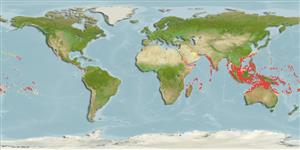
Indo-Pacific: East Africa, Red Sea to Persian Gulf (Ref.80050), to the central Indian Ocean and French Polynesia. Eastern Pacific: Mexico and Panama. The exact range is uncertain because of confusion with Sphyraena jello and Sphyraena putnamae (Ref. 9768).
Taille / Poids / Âge
Maturité: Lm ? range ? - ? cm
Max length : 170 cm TL mâle / non sexé; (Ref. 9710); common length : 80.0 cm TL mâle / non sexé; (Ref. 9768); poids max. publié: 7.1 kg (Ref. 40637)
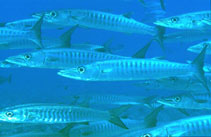
Épines dorsales (Total) : 6; Rayons mous dorsaux (Total) : 9; Épines anales: 2; Rayons mous anaux: 7 - 9. Many dark bars crossing lateral line on body, each bar oblique in upper half, but nearly vertical in the lower; caudal fin largely blackish. No gill rakers on first arch; upper and lower gill arch with rough platelets, each platelet not bearing distinct spine.
Body shape (shape guide): elongated; Cross section: oval.
Found near current-swept lagoon and seaward reefs (Ref. 9710). Feeds on fishes (Ref. 89972). Usually seen in large semi-stationary schools during the day (Ref. 9768) which have a tendency to occupy the same site for months or even years at a time. Probably disperses at night to feed (Ref. 1602). Often hooked by trolling between dusk and dawn (Ref. 37816). Minimum depth reported taken from Ref. 128797.
Cycle de vie et comportement reproducteur
Maturité | Reproduction | Frai | Œufs | Fécondité | Larves
In general, barracudas in large numbers aggegate during spawning season and migrate to specific spawning areas (Ref. 240).
De Sylva, D.P. and F. Williams, 1986. Sphyraenidae. p. 721-726. In M.M. Smith and P.C. Heemstra (eds.) Smiths' sea fishes. Springer-Verlag, Berlin. (Ref. 5491)
Statut dans la liste rouge de l'IUCN (Ref. 130435: Version 2025-2 (Global))
Menace pour l'homme
Reports of ciguatera poisoning (Ref. 4537)
Utilisations par l'homme
Pêcheries: commercial; pêche sportive: oui
Outils
Articles particuliers
Télécharger en XML
Sources Internet
Estimations basées sur des modèles
Température préférée (Réf.
123201): 26.1 - 29, mean 28.1 °C (based on 1626 cells).
Indice de diversité phylogénétique (Réf.
82804): PD
50 = 0.5000 [Uniqueness, from 0.5 = low to 2.0 = high].
Bayesian length-weight: a=0.00708 (0.00326 - 0.01539), b=2.92 (2.74 - 3.10), in cm total length, based on LWR estimates for this Genus-body shape (Ref.
93245).
Niveau trophique (Réf.
69278): 4.5 ±0.80 se; based on food items.
Résilience (Réf.
120179): Très faible, temps minimum de doublement de population supérieur à 14 ans (Preliminary K or Fecundity.).
Vulnérabilité de la pêche (Ref.
59153): Very high vulnerability (90 of 100).
🛈
Nutriments (Ref.
124155): Calcium = 9.8 [4.8, 25.1] mg/100g; Iron = 0.241 [0.113, 0.501] mg/100g; Protein = 20.2 [18.2, 21.9] %; Omega3 = 0.0769 [, ] g/100g; Selenium = 47 [19, 118] μg/100g; VitaminA = 33 [7, 160] μg/100g; Zinc = 0.4 [0.3, 0.7] mg/100g (wet weight);