Taxonomic Remarks
Type locality: Monsembe (Haut Congo).
Περιβάλλον: περιβάλλον / κλιματική ζώνη / εύρος βάθους / εύρος διανομής
Οικολογία
; Γλυκού νερού βενθικό(ς). Tropical; 26°C - 28°C (Ref. 1672)
Africa: Congo River basin in Cameroon, Democratic Republic of the Congo (Ref. 3188, Angola (Ref. 3188, 120641) and Republic of Congo (Ref. 45477). Also reported from the Lake Rukwa drainage (Ref. 27292) and Lake Tanganyika basin (Ref. 4537, 36901, 54847).
Μέγεθος / Βάρος / Ηλικία
Γεννητική Ωρίμανση: Lm ? range ? - ? cm
Max length : 60.0 cm TL αρσενικό/απροσδιόριστο; (Ref. 3188)
Σύντομη περιγραφή
Κλείδες προσδιορισμού | Μορφολογία | Μορφομετρία
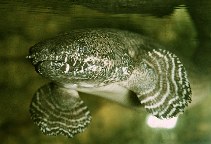
Ραχιαίες άκανθες (συνολικά) : 9 - 11; Εδρικές άκανθες: 14 - 15. Subcylindrical body (Ref. 27292, Ref. 36901). Upper and lower jaw of equal length (Ref. 36901, Ref. 42907). Number of dorsal finlets: 9-11 (Ref. 42908, Ref. 51884). Dorsal fin origin well behind pectoral fin (Ref. 4967, Ref. 42873). Ganoid scales (Ref. 27292, Ref. 42904): 58-65 lateral line scales, 38-44 scales around body, 22-27 predorsal scales (Ref. 2970, Ref. 11970, Ref. 42907, Ref. 42908). Dorsal side grey-brown colored, marbled with clear whitish spots (Ref. 11970), the belly is white to yellowish (Ref. 27292). Head finely reticulated (Ref. 42873, Ref. 42901). Fins with white spots alternating with dark spots, forming a continuous bar (Ref. 11970).
Body shape (shape guide): elongated; Cross section: circular.
Facultative air-breathing (Ref. 126274); Inhabits calm waters of swamps and rivers (Ref. 11970). It feeds on worms and insect larvae when young, but takes larger food, mainly fish, when adult (Ref. 27292). It mainly hunts at night (Ref. 27292). In general they are more or less solitary fish and do not form schools (Ref. 27292).
Κύκλος ζωής και συμπεριφορά ζευγαρώματος
Γεννητική Ωρίμανση | Αναπαραγωγή | Γεννοβολία | Αβγά | Γονιμότητα | Προνύμφες
Male starts with the courtship and is the active partner (Ref. 1672). The male makes from the anal fin a sort of cup and the female lays the eggs in this cup (Ref. 1672). The male then spreads the eggs so that they attach, e.g., to plants.
Gosse, J.-P., 1984. Polypteridae. p. 18-29. In J. Daget, J.-P. Gosse and D.F.E. Thys van den Audenaerde (eds.) Check-list of the freshwater fishes of Africa (CLOFFA). Volume I. ORSTOM, Paris and MRAC, Tervuren. 410 p. (Ref. 3188)
Κατάσταση Κόκκινου Καταλόγου IUCN (Ref. 130435: Version 2025-2 (Global))
Απειλή για τον άνθρωπο
Harmless
Ανθρώπινες χρήσεις
αλιεία: χωρίς ενδιαφέρον; Ενυδρείο: Δημόσια ενυδρεία
Εργαλεία
Ειδικές εκθέσεις
Λήψη XML
Διαδικτυακές πηγές
Εκτιμήσεις βάσει μοντέλων
Δείκτης φυλογενετικής ποικιλότητας (Αναφ.
82804): PD
50 = 0.5003 [Uniqueness, from 0.5 = low to 2.0 = high].
Bayesian length-weight: a=0.00457 (0.00194 - 0.01077), b=3.05 (2.85 - 3.25), in cm total length, based on LWR estimates for this (Sub)family-body shape (Ref.
93245).
Τροφικό Επίπεδο (Αναφ.
69278): 3.7 ±0.60 se; based on food items.
Ελαστικότητα (Αναφ.
120179): Χαμηλό, ελάχιστος χρόνος για διπλασιασμό πληθυσμού 4,5 - 14 έτη (Fec=200-300; tmax likely >= 20).
Ευπάθεια στην αλιεία (Ref.
59153): Moderate vulnerability (44 of 100).
🛈