>
Ophidiiformes (Cusk eels) >
Ophidiidae (Cusk-eels) > Brotulinae
Etymology: Brotula: Latin, brotula, -ae = little, bud, shoot (Ref. 45335).
Eponymy: Dr Frances Naomi Clark (1894–1987) was the only woman in the male-dominated field of marine biology. [...] (Ref. 128868), visit book page.
More on author: Hubbs.
Environnement : milieu / zone climatique / profondeur / gamme de distribution
Écologie
marin benthopélagique; profondeur ? - 650 m (Ref. 34024), usually 40 - 75 m (Ref. 36413). Tropical; 25°N - 6°S
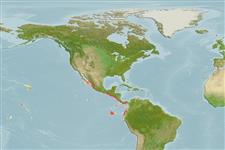
Eastern Central Pacific: Gulf of California to Peru.
Longueur à la première maturité / Taille / Poids / Âge
Maturité: Lm 75.4 range ? - ? cm
Max length : 115 cm TL mâle / non sexé; (Ref. 55763); common length : 45.0 cm TL mâle / non sexé; (Ref. 55763)
Description synthétique
Clés d'identification | Morphologie | Morphométrie
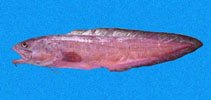
Épines dorsales (Total) : 0; Rayons mous dorsaux (Total) : 108 - 118; Épines anales: 0; Rayons mous anaux: 78 - 89; Vertèbres: 55 - 56. Body completely covered with small, imbricate, cycloid scales; barbels present on snout (6) and chin (6); branchiostegal rays 8; median basibranchial tooth patch absent; developed gill rakers on first arch 4 or fewer; pelvic fin rays inserted at about level of preopercle, well behind eye (Ref. 34024).
Body shape (shape guide): elongated.
Adults benthopelagic to 650 m depth, juveniles common on reefs (Ref. 34024). At depths of about 40-75 m, adults are found deep on mud and broken shell bottom (Ref. 36413). Smaller silvery specimens taken far out at sea in the epipelagic (Ref. 34024). Caught occasionally (Ref. 34024). Oviparous, with late post-flexion and transformation stage larvae found in midwater (Ref. 36413). Oval, pelagic eggs float in a gelatinous mass (Ref. 205).
Cycle de vie et comportement reproducteur
Maturité | Reproduction | Frai | Œufs | Fécondité | Larves
Oviparous, with no specialized copulatory organ (Ref. 36413).
Nielsen, J.G., D.M. Cohen, D.F. Markle and C.R. Robins, 1999. Ophidiiform fishes of the world (Order Ophidiiformes). An annotated and illustrated catalogue of pearlfishes, cusk-eels, brotulas and other ophidiiform fishes known to date. FAO Fish. Synop. 125(18):178p. Rome: FAO. (Ref. 34024)
Statut dans la liste rouge de l'IUCN (Ref. 130435: Version 2025-2 (Global))
Menace pour l'homme
Harmless
Utilisations par l'homme
Pêcheries: intérêt commercial mineur
Outils
Articles particuliers
Télécharger en XML
Sources Internet
Estimations basées sur des modèles
Température préférée (Réf.
123201): 16 - 25.2, mean 19.4 °C (based on 24 cells).
Indice de diversité phylogénétique (Réf.
82804): PD
50 = 0.5078 [Uniqueness, from 0.5 = low to 2.0 = high].
Bayesian length-weight: a=0.00355 (0.00199 - 0.00632), b=3.14 (2.98 - 3.30), in cm total length, based on LWR estimates for this species & (Sub)family-body (Ref.
93245).
Niveau trophique (Réf.
69278): 4.1 ±0.77 se; based on food items.
Résilience (Réf.
120179): Milieu, temps minimum de doublement de population : 1,4 à 4,4 années (Preliminary K or Fecundity.).
Prior r = 0.38, 95% CL = 0.25 - 0.57, Based on 1 data-limited stock assessment.
Vulnérabilité de la pêche (Ref.
59153): Moderate to high vulnerability (45 of 100).
🛈
Nutriments (Ref.
124155): Calcium = 56.5 [31.2, 137.3] mg/100g; Iron = 0.759 [0.396, 1.366] mg/100g; Protein = 16.2 [13.7, 18.7] %; Omega3 = 0.202 [0.105, 0.413] g/100g; Selenium = 151 [68, 350] μg/100g; VitaminA = 11.9 [3.5, 39.7] μg/100g; Zinc = 0.728 [0.481, 1.126] mg/100g (wet weight);