>
Gadiformes (Cods) >
Macrouridae (Grenadiers or rattails)
Etymology: Albatrossia: The name of an oceanographic ship "Albatross" (1888-1900) (Ref. 45335); pectoralis: pectoralis refering to the long and narrow pectoral fin (Ref. 6885).
Eponymy: ‘Albatross’ was a steam-driven research vessel owned by the US Fish Commission. It was used for many cruises and expeditions. The greeneye species was collected when the ‘Albatross’ dredged off the coast of Japan. (Ref. 128868), visit book page.
More on author: Gilbert.
Umwelt: Milieu / Klimazone / Tiefenbereich / Verbreitungsgebiet
Ökologie
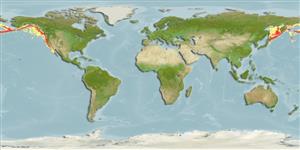
seewasser bathydemersal; standorttreu; tiefenbereich 140 - 3500 m (Ref. 50550), usually 700 - 1100 m (Ref. 56476). Deep-water; 62°N - 26°N, 143°E - 115°W (Ref. 1371)
North Pacific: northern Japan to the Okhotsk and Bering seas, east to the Gulf of Alaska, south to northern Baja California in Mexico.
Länge bei der ersten Reifung / Größe / Gewicht / Alter
Geschlechtsreife: Lm 83.2, range 65 - 102 cm
Max length : 210 cm TL Männchen/unbestimmt; (Ref. 56527); common length : 85.0 cm Männchen/unbestimmt; (Ref. 56527); max. veröff. Gewicht: 86.0 kg (Ref. 56527); max. veröff. Alter: 56 Jahre (Ref. 39270)
Kurzbeschreibung
Bestimmungsschlüssel | Morphologie | Morphometrie
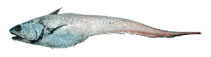
Rückenflossenstacheln (insgesamt) : 2; Rückenflossenweichstrahlen (insgesamt) : 7 - 9; Afterflossenstacheln: 0; Afterflossenweichstrahlen: 131. Snout low, slightly protruding beyond the large mouth, without a spinous terminal scute. Scales small, slightly oblong, with moderate-sized median ridge, without spines or with few weak spinules, and 0 to 5 much lower, non-spinulated ridges laterally on exposed field. Swim bladder small, with 2 retia mirabilia. Gray-brown on head and body, each scale with a prominent dark posterior border, fins and lateral line darker; black in mouth, gill cavity, and on peritoneum (Ref. 6885). Branchiostegal rays: 6-6; pyloric caeca: 12-16;
Body shape (shape guide): elongated; Cross section: oval.
Young apparently bathypelagic to some degree but become bathydemersal at a size of 50-60 cm (Ref. 1371). Adults feed mainly on cephalopods, fish and shrimps; other food items include ctenophores, echinoderms, worms, crabs, and amphipods (Ref. 1371). Oviparous, with planktonic larvae (Ref. 36385).
Cohen, D.M., T. Inada, T. Iwamoto and N. Scialabba, 1990. FAO species catalogue. Vol. 10. Gadiform fishes of the world (Order Gadiformes). An annotated and illustrated catalogue of cods, hakes, grenadiers and other gadiform fishes known to date. FAO Fish. Synop. 125(10). Rome: FAO. 442 p. (Ref. 1371)
IUCN Rote Liste Status (Ref. 130435: Version 2025-2 (Global))
Bedrohung für Menschen
Harmless
Nutzung durch Menschen
Fischereien: kommerziell
Tools
Zusatzinformationen
Download XML
Internet Quellen
Schätzungen auf der Grundlage von Modellen
Bevorzugte Temperatur (Ref.
123201): 2.2 - 3.5, mean 2.6 °C (based on 120 cells).
Phylogenetischer Diversitätsindex (Ref.
82804): PD
50 = 1.0000 [Uniqueness, from 0.5 = low to 2.0 = high].
Bayesian length-weight: a=0.00089 (0.00059 - 0.00136), b=3.25 (3.12 - 3.38), in cm total length, based on LWR estimates for this species & (Sub)family-body (Ref.
93245).
Trophische Ebene (Ref.
69278): 4.3 ±0.7 se; based on diet studies.
Widerstandsfähigkeit (Ref.
120179): sehr niedrig, Verdopplung der Population dauert mehr als 14 Jahre. (tmax >30).
Anfälligkeit der Fischerei (Ref.
59153): High to very high vulnerability (70 of 100).
🛈
Nährstoffe (Ref.
124155): Calcium = 10.4 [5.3, 23.0] mg/100g; Iron = 0.303 [0.155, 0.627] mg/100g; Protein = 17.2 [15.5, 18.9] %; Omega3 = 0.226 [0.101, 0.496] g/100g; Selenium = 41 [17, 98] μg/100g; VitaminA = 4.24 [0.83, 19.44] μg/100g; Zinc = 0.232 [0.151, 0.366] mg/100g (wet weight);