>
Scombriformes (Mackerels) >
Gempylidae (Snake mackerels)
Etymology: Rexea: Latin, rex, rego = king.
Eponymy: Daniel Carl [Karl] Solander (1733–1782) was a Swedish naturalist and explorer who was one of Linnaeus’s pupils at Uppsala. [...] (Ref. 128868), visit book page.
More on author: Cuvier.
Ambiente: milieu / zona climatica / distribuzione batimetrica / gamma di distribuzione
Ecologia
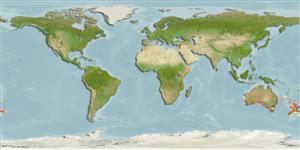
marino benthopelagico; oceanodromo (Ref. 51243); distribuzione batimetrica 100 - 800 m (Ref. 6181), usually 300 - 450 m (Ref. 28786). Deep-water; 25°S - 48°S, 109°E - 173°W (Ref. 6181)
Southwest Pacific: off southern, southwestern and southeastern Australia, Tasmania and New Zealand. Occurrence records from Madagascar and Japan need to be verified.
Lunghezza alla prima maturità / Dimensione / Peso / Età
Maturità: Lm 65.0, range 60 - 70 cm
Max length : 110 cm SL maschio/sesso non determinato; (Ref. 6181); peso massimo pubblicato: 16.0 kg (Ref. 28838); Età massima riportata: 16 anni (Ref. 28789)
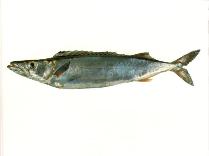
Spine dorsali (totale) : 18 - 19; Raggi dorsali molli (totale) : 16 - 19; Spine anali: 2; Raggi anali molli: 13 - 16; Vertebre: 36. Body entirely scaled at over 25 cm SL. Lateral line branching below the 5th to the 6th spine of the first dorsal fin. The upper branch reaches beyond the origin of the second dorsal fin, usually ending between the 8th to the 12th soft ray. The lower branch runs mid laterally, undulating above the anal-fin base. Body is bluish above, silvery below, a black blotch distally on two anterior membranes of the first dorsal fin, the rest of the fin is grayish.
Body shape (shape guide): elongated; Cross section: compressed.
Found in schools on continental shelf and slope. They are normally caught close to the sea bed but probably move into midwater at times (Ref. 28786). Juveniles are pelagic, adults also occur near the surface off Tasmania and New Zealand. Dense schools of pre-spawners migrate along the continental slope at about 400 m during winter (Ref. 9563). Feed on fish, squid and crustaceans. The flesh is of good edible quality and especially tasty when smoked. In Australia, the eastern gemfish stock has been subjected to a prolonged period of poor recruitment which started in 1989 (Ref. 28843, 28786). This event resulted in a very significant decline in the gemfish resource. In Australia, efforts are now being channeled towards the recovery of the fishery.
Larvae are caught in inshore waters which may indicate that gemfish move onto the shelf to spawn, or currents carry larvae in from offshore spawning grounds (Ref. 28786).
Nakamura, I. and N.V. Parin, 1993. FAO Species Catalogue. Vol. 15. Snake mackerels and cutlassfishes of the world (families Gempylidae and Trichiuridae). An annotated and illustrated catalogue of the snake mackerels, snoeks, escolars, gemfishes, sackfishes, domine, oilfish, cutlassfishes,. scabbardfishes, hairtails, and frostfishes known to date. FAO Fish. Synop. 125(15):136 p. (Ref. 6181)
Stato della Lista Rossa IUCN (Ref. 130435: Version 2025-2 (Global))
Minaccia per l'uomo
Harmless
Usi umani
Pesca: commerciale
Strumenti
Rapporti speciali
Scarica XML
Fonti Internet
Stime basate su modelli
Temperatura preferita (Fonte Biblio.
123201): 8.4 - 13.6, mean 10.4 °C (based on 52 cells).
Indice di diversità filogenetica (Fonte Biblio.
82804): PD
50 = 0.5078 [Uniqueness, from 0.5 = low to 2.0 = high].
Bayesian length-weight: a=0.00347 (0.00194 - 0.00621), b=3.14 (2.98 - 3.30), in cm total length, based on LWR estimates for this species & (Sub)family-body (Ref.
93245).
Livello trofico (Fonte Biblio.
69278): 4.3 ±0.66 se; based on food items.
Generation time: 5.4 (4.5 - 6.6) years. Estimated as median ln(3)/K based on 14
growth studies.
Resilienza (Fonte Biblio.
120179): Basso, tempo minimo di raddoppiamento della popolazione 4.5 - 14 anni (K=0.11-0.21; tm=3-6; tmax=16; Fec=500,000).
Prior r = 0.43, 95% CL = 0.28 - 0.64, Based on 2 full stock assessments.
Vulnerabilità della pesca (Ref.
59153): High vulnerability (58 of 100).
🛈
Vulnerabilità climatica (Ref.
125649): High to very high vulnerability (65 of 100).
🛈
Nutrienti (Ref.
124155): Calcium = 11 [4, 29] mg/100g; Iron = 0.306 [0.113, 0.902] mg/100g; Protein = 15.6 [13.2, 18.3] %; Omega3 = 0.228 [0.114, 0.465] g/100g; Selenium = 25.8 [10.5, 61.4] μg/100g; VitaminA = 15.4 [3.4, 72.8] μg/100g; Zinc = 0.291 [0.195, 0.444] mg/100g (wet weight); based on
nutrient studies.