>
Scombriformes (Mackerels) >
Gempylidae (Snake mackerels)
Etymology: Rexea: Latin, rex, rego = king.
Eponymy: Daniel Carl [Karl] Solander (1733–1782) was a Swedish naturalist and explorer who was one of Linnaeus’s pupils at Uppsala. [...] (Ref. 128868), visit book page.
More on author: Cuvier.
Entorno: milieu / zona climática / rango de profundidad / gama de distribución
Ecología
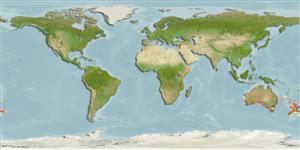
marino bentopelágico; oceanodromo (Ref. 51243); rango de profundidad 100 - 800 m (Ref. 6181), usually 300 - 450 m (Ref. 28786). Deep-water; 25°S - 48°S, 109°E - 173°W (Ref. 6181)
Southwest Pacific: off southern, southwestern and southeastern Australia, Tasmania and New Zealand. Occurrence records from Madagascar and Japan need to be verified.
Longitud en la primera madurez / Tamaño / Peso / Edad
Madurez: Lm 65.0, range 60 - 70 cm
Max length : 110 cm SL macho / no sexado; (Ref. 6181); peso máximo publicado: 16.0 kg (Ref. 28838); edad máxima reportada: 16 años (Ref. 28789)
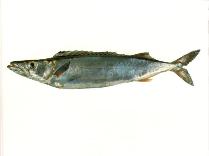
Espinas dorsales (total) : 18 - 19; Radios blandos dorsales (total) : 16 - 19; Espinas anales: 2; Radios blandos anales: 13 - 16; Vértebra: 36. Body entirely scaled at over 25 cm SL. Lateral line branching below the 5th to the 6th spine of the first dorsal fin. The upper branch reaches beyond the origin of the second dorsal fin, usually ending between the 8th to the 12th soft ray. The lower branch runs mid laterally, undulating above the anal-fin base. Body is bluish above, silvery below, a black blotch distally on two anterior membranes of the first dorsal fin, the rest of the fin is grayish.
Body shape (shape guide): elongated; Cross section: compressed.
Found in schools on continental shelf and slope. They are normally caught close to the sea bed but probably move into midwater at times (Ref. 28786). Juveniles are pelagic, adults also occur near the surface off Tasmania and New Zealand. Dense schools of pre-spawners migrate along the continental slope at about 400 m during winter (Ref. 9563). Feed on fish, squid and crustaceans. The flesh is of good edible quality and especially tasty when smoked. In Australia, the eastern gemfish stock has been subjected to a prolonged period of poor recruitment which started in 1989 (Ref. 28843, 28786). This event resulted in a very significant decline in the gemfish resource. In Australia, efforts are now being channeled towards the recovery of the fishery.
Larvae are caught in inshore waters which may indicate that gemfish move onto the shelf to spawn, or currents carry larvae in from offshore spawning grounds (Ref. 28786).
Nakamura, I. and N.V. Parin, 1993. FAO Species Catalogue. Vol. 15. Snake mackerels and cutlassfishes of the world (families Gempylidae and Trichiuridae). An annotated and illustrated catalogue of the snake mackerels, snoeks, escolars, gemfishes, sackfishes, domine, oilfish, cutlassfishes,. scabbardfishes, hairtails, and frostfishes known to date. FAO Fish. Synop. 125(15):136 p. (Ref. 6181)
Situación en la Lista Roja de la UICN (Ref. 130435: Version 2025-2 (Global))
Amenaza para el ser humano
Harmless
Usos humanos
Pesquerías: comercial
Herramientas
Informes especiales
Descargar XML
Fuentes de Internet
Estimaciones basadas en modelos
Temperatura preferida (Referencia
123201): 8.4 - 13.6, mean 10.4 °C (based on 52 cells).
Índice de diversidad filogenética (Referencia
82804): PD
50 = 0.5078 [Uniqueness, from 0.5 = low to 2.0 = high].
Bayesian length-weight: a=0.00347 (0.00194 - 0.00621), b=3.14 (2.98 - 3.30), in cm total length, based on LWR estimates for this species & (Sub)family-body (Ref.
93245).
Nivel trófico (Referencia
69278): 4.3 ±0.66 se; based on food items.
Generation time: 5.4 (4.5 - 6.6) years. Estimated as median ln(3)/K based on 14
growth studies.
Resiliencia (Referencia
120179): Bajo, población duplicada en un tiempo mínimo de 4.5-14 años (K=0.11-0.21; tm=3-6; tmax=16; Fec=500,000).
Prior r = 0.43, 95% CL = 0.28 - 0.64, Based on 2 full stock assessments.
Vulnerabilidad pesquera (Ref.
59153): High vulnerability (58 of 100).
🛈
Vulnerabilidad climática (Ref.
125649): High to very high vulnerability (65 of 100).
🛈
Nutrientes (Ref.
124155): Calcium = 11 [4, 29] mg/100g; Iron = 0.306 [0.113, 0.902] mg/100g; Protein = 15.6 [13.2, 18.3] %; Omega3 = 0.228 [0.114, 0.465] g/100g; Selenium = 25.8 [10.5, 61.4] μg/100g; VitaminA = 15.4 [3.4, 72.8] μg/100g; Zinc = 0.291 [0.195, 0.444] mg/100g (wet weight); based on
nutrient studies.