>
Gadiformes (Cods) >
Macrouridae (Grenadiers or rattails)
Etymology: Ventrifossa: Latin, venter, ventris = belly + Latin, fosa = pit (Ref. 45335).
Eponymy: Dr Samuel Trevor Walton Garman (1843–1927) was an American naturalist, most noted as an ichthyologist and herpetologist. [...] (Ref. 128868), visit book page.
More on authors: Jordan & Gilbert.
Umwelt: Milieu / Klimazone / Tiefenbereich / Verbreitungsgebiet
Ökologie
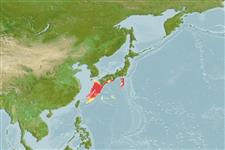
seewasser bathydemersal; standorttreu; tiefenbereich 200 - 720 m (Ref. 1371), usually 350 - 550 m (Ref. 1371). Deep-water; 34°N - 24°N, 125°E - 140°E (Ref. 1371)
Northwest Pacific: southern Japan and East China Sea.
Größe / Gewicht / Alter
Geschlechtsreife: Lm ? range ? - ? cm
Max length : 31.0 cm TL Männchen/unbestimmt; (Ref. 1371)
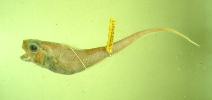
Rückenflossenstacheln (insgesamt) : 2; Afterflossenstacheln: 0. Snout short, conical; eyes large, its diameter greater than snout length. Scales medium-sized, uniformly covered with broad, short, triangular spinules in widely divergent V rows or irregularly quincunx order. Snout with a black margin along its leading edge; first dorsal fin uniformly dusky or darker proximally, but lacking a distinct black blotch.
Body shape (shape guide): elongated; Cross section: oval.
Most common in about 350 to 550 m where water temperatures range from 6° to 12°C. Feeds primarily on euphausiids, prawns, and isopods. Spawning probably takes place in early spring.
Lebenszyklus und Paarungsverhalten
Geschlechtsreife | Fortpflanzung | Ablaichen | Eier | Fruchtbarkeit | Larven
Cohen, D.M., T. Inada, T. Iwamoto and N. Scialabba, 1990. FAO species catalogue. Vol. 10. Gadiform fishes of the world (Order Gadiformes). An annotated and illustrated catalogue of cods, hakes, grenadiers and other gadiform fishes known to date. FAO Fish. Synop. 125(10). Rome: FAO. 442 p. (Ref. 1371)
IUCN Rote Liste Status (Ref. 130435: Version 2025-2 (Global))
Bedrohung für Menschen
Harmless
Nutzung durch Menschen
Fischereien: weniger kommerziell
Tools
Zusatzinformationen
Download XML
Internet Quellen
Schätzungen auf der Grundlage von Modellen
Bevorzugte Temperatur (Ref.
123201): 7.6 - 13.7, mean 11.1 °C (based on 21 cells).
Phylogenetischer Diversitätsindex (Ref.
82804): PD
50 = 0.5000 [Uniqueness, from 0.5 = low to 2.0 = high].
Bayesian length-weight: a=0.00219 (0.00111 - 0.00432), b=3.20 (3.03 - 3.37), in cm total length, based on LWR estimates for this (Sub)family-body shape (Ref.
93245).
Trophische Ebene (Ref.
69278): 3.5 ±0.52 se; based on food items.
Widerstandsfähigkeit (Ref.
120179): mittel, Verdopplung der Population dauert 1,4 - 4,4 Jahre. (Preliminary K or Fecundity.).
Anfälligkeit der Fischerei (Ref.
59153): Low vulnerability (21 of 100).
🛈
Nährstoffe (Ref.
124155): Calcium = 35.6 [19.1, 80.9] mg/100g; Iron = 0.456 [0.221, 0.929] mg/100g; Protein = 16.6 [14.8, 18.3] %; Omega3 = 0.243 [0.110, 0.515] g/100g; Selenium = 18.5 [7.3, 43.5] μg/100g; VitaminA = 12.5 [2.5, 56.8] μg/100g; Zinc = 0.476 [0.313, 0.737] mg/100g (wet weight);