Elasmobranchii (Haie und Rochen) (sharks and rays) >
Carcharhiniformes (Ground sharks) >
Carcharhinidae (Requiem sharks)
Etymology: Carcharhinus: karcharos (Gr.), sharp or jagged; rhinus, an ancient name for sharks, from rhine (Gr.), rasp, both words alluding to a shark's jagged, rasp-like skin (See ETYFish); hemiodon: hemi-, from hemisys (Gr.), half; odon (Gr.), tooth, allusion not explained, perhaps referring to how teeth on upper jaw are serrated basally and smooth distally (See ETYFish).
Umwelt: Milieu / Klimazone / Tiefenbereich / Verbreitungsgebiet
Ökologie
seewasser; brackwasser demersal; amphidrom (Ref. 51243); tiefenbereich 10 - 150 m (Ref. 106604). Deep-water; 25°N - 13°S
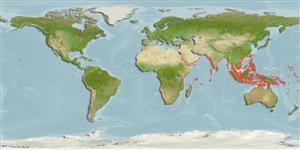
Indo-West Pacific: Gulf of Oman to Pakistan, India, and possibly Sri Lanka. Scattered localities from the eastern Indian Ocean and the western Pacific ranging from India to New Guinea.
Größe / Gewicht / Alter
Geschlechtsreife: Lm ? range ? - ? cm
Max length : 200 cm TL Männchen/unbestimmt; (Ref. 9997)
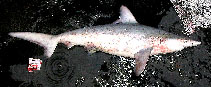
Rückenflossenstacheln (insgesamt) : 0; Afterflossenstacheln: 0. Grey above, white below, with the tips of the pectorals, and upper and lower caudal-fin lobes black; other fins dusky (Ref. 9997).
Body shape (shape guide): fusiform / normal.
A little-known shark found on the continental and insular shelves (Ref. 244). Reports from river mouths and rivers are based on old records that need verification (Ref. 9997). Probably feeds on small fishes, cephalopods, and crustaceans (Ref. 9997). Viviparous (Ref. 50449). Utilized fresh for human consumption (Ref. 9997).
Lebenszyklus und Paarungsverhalten
Geschlechtsreife | Fortpflanzung | Ablaichen | Eier | Fruchtbarkeit | Larven
Distinct pairing with embrace (Ref. 205). Viviparous, placental (Ref. 50449).
Compagno, L.J.V., 1984. FAO Species Catalogue. Vol. 4. Sharks of the world. An annotated and illustrated catalogue of shark species known to date. Part 2 - Carcharhiniformes. FAO Fish. Synop. 125(4/2):251-655. Rome: FAO. (Ref. 244)
IUCN Rote Liste Status (Ref. 130435: Version 2025-2 (Global))
Nutzung durch Menschen
Fischereien: kleinfischerei
Tools
Zusatzinformationen
Download XML
Internet Quellen
Schätzungen auf der Grundlage von Modellen
Bevorzugte Temperatur (Ref.
123201): 25.2 - 29.1, mean 28.3 °C (based on 844 cells).
Phylogenetischer Diversitätsindex (Ref.
82804): PD
50 = 0.5000 [Uniqueness, from 0.5 = low to 2.0 = high].
Bayesian length-weight: a=0.00525 (0.00244 - 0.01130), b=3.07 (2.90 - 3.24), in cm total length, based on LWR estimates for this Genus-body shape (Ref.
93245).
Trophische Ebene (Ref.
69278): 4.2 ±0.58 se; based on food items.
Widerstandsfähigkeit (Ref.
120179): niedrig, Verdopplung der Population dauert 4,5 - 14 Jahre. (Fec assumed to be <100).
Anfälligkeit der Fischerei (Ref.
59153): Very high vulnerability (90 of 100).
🛈