>
Eupercaria/misc (Various families in series Eupercaria) >
Sparidae (Porgies)
Etymology: Pagellus: Diminutive of Latin, pager, derived from Greek, pagros = a fish, Dentex sp. (Ref. 45335).
Ambiente: milieu / zona climática / intervalo de profundidade / gama de distribuição
Ecologia
marinhas bentopelágico; intervalo de profundidade 150 - 700 m (Ref. 56504), usually 150 - 300 m (Ref. 35388). Temperate; 65°N - 20°N, 32°W - 37°E
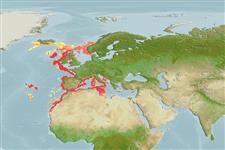
Eastern Atlantic: Norway, Strait of Gibraltar to Cape Blanc in Mauritania, Madeira, Canary Islands, and western Mediterranean (rare beyond the Sicilian Strait).
Comprimento na primeira maturidade / Tamanho / Peso / Idade
Maturidade: Lm 31.4 range ? - ? cm
Max length : 70.0 cm SL macho/indeterminado; (Ref. 4781); common length : 30.0 cm SL macho/indeterminado; (Ref. 4781); peso máx. Publicado: 4.0 kg (Ref. 9987); Idade máx. registada: 15 anos (Ref. 4645)
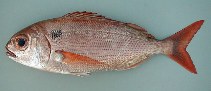
Espinhos dorsais (total) : 12 - 13; Raios dorsais moles (total) : 11 - 13; Espinhos anais: 3; Raios anais moles: 11 - 12. Black spot above the pectoral fin base. Snout shorter than the eye diameter (Ref. 35388).
Body shape (shape guide): fusiform / normal.
Inshore waters above various types of bottom (rocks, sand, mud) to 400 m (Mediterranean) and 700 m (Atlantic); young near the coast, adults on the continental slope specially over muddy bottoms. Omnivorous, but feed mainly on crustaceans, mollusks, worms and small fish. Protandric hermaphrodites, become females at 20-30 cm length. Adults move towards the coast up to the edge of the continental shelf to spawn from January to June (Ref. 3688). Important foodfish. Marketed fresh and frozen; consumed pan-fried, broiled and baked (Ref. 9987).
Protandric hermaphrodite species (male during its first sexual maturity). Becomes female between 2 and 7 years of age. Spawns from January to June, depending on latitude. Egg size 1.19 mm, larval length at hatching 3.7 mm. Simultaneous hermaphroditism is also suggested for this species (Ref. 103751).
Bauchot, M.-L. and J.-C. Hureau, 1990. Sparidae. p. 790-812. In J.C. Quero, J.C. Hureau, C. Karrer, A. Post and L. Saldanha (eds.) Check-list of the fishes of the eastern tropical Atlantic (CLOFETA). JNICT, Lisbon; SEI, Paris; and UNESCO, Paris. Vol. 2. (Ref. 3688)
Categoria na Lista Vermelha da IUCN (Ref. 130435: Version 2025-2 (Global))
Ameaça para o homem
Harmless
Utilização humana
Pescarias: espécies comerciais; peixe desportivo: sim
Ferramentas
Relatórios especiais
Descarregue XML
Fontes da internet
Estimativas baseadas em modelos
Temperatura preferida (Ref.
123201): 6.9 - 14.9, mean 11.2 °C (based on 160 cells).
Índice de diversidade filogenética (Ref.
82804): PD
50 = 0.5156 [Uniqueness, from 0.5 = low to 2.0 = high].
Bayesian length-weight: a=0.01122 (0.00996 - 0.01263), b=3.03 (3.00 - 3.06), in cm total length, based on LWR estimates for this species (Ref.
93245).
Nível Trófico (Ref.
69278): 4.2 ±0.6 se; based on diet studies.
Generation time: 8.5 (6.5 - 9.3) years. Estimated as median ln(3)/K based on 15
growth studies.
Resiliência (Ref.
120179): Médio, tempo mínimo de duplicação da população 1,4 - 4,4 anos (K=0.09-0.1; tmax=15; tm=4-5; Fec=70,000).
Prior r = 0.51, 95% CL = 0.34 - 0.77, Based on 4 full stock assessments.
Vulnerabilidade da pesca (Ref.
59153): High vulnerability (64 of 100).
🛈
Vulnerabilidade climática (Ref.
125649): Moderate to high vulnerability (45 of 100).
🛈
Nutrientes (Ref.
124155): Calcium = 41.2 [17.9, 69.5] mg/100g; Iron = 0.167 [0.103, 0.268] mg/100g; Protein = 19.5 [18.2, 20.8] %; Omega3 = 0.742 [0.486, 1.122] g/100g; Selenium = 47.9 [24.1, 97.4] μg/100g; VitaminA = 10.4 [2.1, 53.0] μg/100g; Zinc = 0.275 [0.208, 0.378] mg/100g (wet weight); based on
nutrient studies.