>
Eupercaria/misc (Various families in series Eupercaria) >
Sparidae (Porgies)
Etymology: Pagellus: Diminutive of Latin, pager, derived from Greek, pagros = a fish, Dentex sp. (Ref. 45335).
Entorno: milieu / zona climática / rango de profundidad / gama de distribución
Ecología
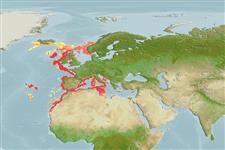
marino bentopelágico; rango de profundidad 150 - 700 m (Ref. 56504), usually 150 - 300 m (Ref. 35388). Temperate; 65°N - 20°N, 32°W - 37°E
Eastern Atlantic: Norway, Strait of Gibraltar to Cape Blanc in Mauritania, Madeira, Canary Islands, and western Mediterranean (rare beyond the Sicilian Strait).
Longitud en la primera madurez / Tamaño / Peso / Edad
Madurez: Lm 31.4 range ? - ? cm
Max length : 70.0 cm SL macho / no sexado; (Ref. 4781); common length : 30.0 cm SL macho / no sexado; (Ref. 4781); peso máximo publicado: 4.0 kg (Ref. 9987); edad máxima reportada: 15 años (Ref. 4645)
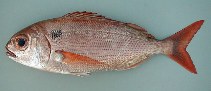
Espinas dorsales (total) : 12 - 13; Radios blandos dorsales (total) : 11 - 13; Espinas anales: 3; Radios blandos anales: 11 - 12. Black spot above the pectoral fin base. Snout shorter than the eye diameter (Ref. 35388).
Body shape (shape guide): fusiform / normal.
Inshore waters above various types of bottom (rocks, sand, mud) to 400 m (Mediterranean) and 700 m (Atlantic); young near the coast, adults on the continental slope specially over muddy bottoms. Omnivorous, but feed mainly on crustaceans, mollusks, worms and small fish. Protandric hermaphrodites, become females at 20-30 cm length. Adults move towards the coast up to the edge of the continental shelf to spawn from January to June (Ref. 3688). Important foodfish. Marketed fresh and frozen; consumed pan-fried, broiled and baked (Ref. 9987).
Protandric hermaphrodite species (male during its first sexual maturity). Becomes female between 2 and 7 years of age. Spawns from January to June, depending on latitude. Egg size 1.19 mm, larval length at hatching 3.7 mm. Simultaneous hermaphroditism is also suggested for this species (Ref. 103751).
Bauchot, M.-L. and J.-C. Hureau, 1990. Sparidae. p. 790-812. In J.C. Quero, J.C. Hureau, C. Karrer, A. Post and L. Saldanha (eds.) Check-list of the fishes of the eastern tropical Atlantic (CLOFETA). JNICT, Lisbon; SEI, Paris; and UNESCO, Paris. Vol. 2. (Ref. 3688)
Situación en la Lista Roja de la UICN (Ref. 130435: Version 2025-2 (Global))
Amenaza para el ser humano
Harmless
Usos humanos
Pesquerías: comercial; pesca deportiva: si
Herramientas
Informes especiales
Descargar XML
Fuentes de Internet
Estimaciones basadas en modelos
Temperatura preferida (Referencia
123201): 6.9 - 14.9, mean 11.2 °C (based on 160 cells).
Índice de diversidad filogenética (Referencia
82804): PD
50 = 0.5156 [Uniqueness, from 0.5 = low to 2.0 = high].
Bayesian length-weight: a=0.01122 (0.00996 - 0.01263), b=3.03 (3.00 - 3.06), in cm total length, based on LWR estimates for this species (Ref.
93245).
Nivel trófico (Referencia
69278): 4.2 ±0.6 se; based on diet studies.
Generation time: 8.5 (6.5 - 9.3) years. Estimated as median ln(3)/K based on 15
growth studies.
Resiliencia (Referencia
120179): Medio, población duplicada en un tiempo mínimo de 1.4-4.4 años (K=0.09-0.1; tmax=15; tm=4-5; Fec=70,000).
Prior r = 0.51, 95% CL = 0.34 - 0.77, Based on 4 full stock assessments.
Vulnerabilidad pesquera (Ref.
59153): High vulnerability (64 of 100).
🛈
Vulnerabilidad climática (Ref.
125649): Moderate to high vulnerability (45 of 100).
🛈
Nutrientes (Ref.
124155): Calcium = 41.2 [17.9, 69.5] mg/100g; Iron = 0.167 [0.103, 0.268] mg/100g; Protein = 19.5 [18.2, 20.8] %; Omega3 = 0.742 [0.486, 1.122] g/100g; Selenium = 47.9 [24.1, 97.4] μg/100g; VitaminA = 10.4 [2.1, 53.0] μg/100g; Zinc = 0.275 [0.208, 0.378] mg/100g (wet weight); based on
nutrient studies.