Élasmobranches (requins et raies) (sharks and rays) >
Myliobatiformes (Stingrays) >
Dasyatidae (Stingrays) > Dasyatinae
Etymology: Dasyatis: Greek, dasys = rough, dense (Ref. 45335).
More on author: Steindachner.
Environnement : milieu / zone climatique / profondeur / gamme de distribution
Écologie
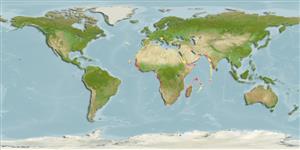
marin démersal; profondeur 12 - 65 m (Ref. 4438). Tropical; 37°N - 36°S, 18°W - 35°E
Eastern Atlantic and Mediterranean Sea: Central to South Eastern Atlantic: Morocco, Mauritania to Congo (Ref. 33465) to Natal, South Africa (Ref. 5578); Mediterranean Sea: the records are patchy along the northern coast of Africa, and in Aegean Sea and Levantine Basin, most likely due to misidentification with other Dasyatidae spp. (Ref. 122045 and others cited).
Taille / Poids / Âge
Maturité: Lm ? range ? - ? cm
Max length : 74.5 cm TL mâle / non sexé; (Ref. 123700)
Description synthétique
Clés d'identification | Morphologie | Morphométrie
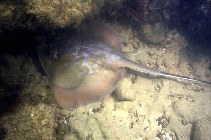
Épines dorsales (Total) : 0. Conspicuous bright blue blotches and branching lines on a golden brown disc; snout and disc angular, and tail less than twice body length with a short upper caudal finfold, and a longer lower one falling far in front of tail tip; disc without thorns; usually one sting (Ref. 5578). Underside white, tail darker and without bands (Ref. 5578).
Body shape (shape guide): other.
Close inshore, found on sandy beaches and in shallow bays (Ref. 5578), sometimes near rocky reefs (Ref. 12951). Found in deeper offshore areas during the winter season (Ref. 12951). Feeds on crabs, mantis shrimps, amphipods, worms, and fishes (Ref. 12951). Ovoviviparous (Ref. 50449). Minimum depth reported from Ref. 4438. Disc width measures 30 cm. Its thorny, venomous hooks can cause painful injuries (Ref. 5377).
Cycle de vie et comportement reproducteur
Maturité | Reproduction | Frai | Œufs | Fécondité | Larves
Exhibit ovoviparity (aplacental viviparity), with embryos feeding initially on yolk, then receiving additional nourishment from the mother by indirect absorption of uterine fluid enriched with mucus, fat or protein through specialised structures (Ref. 50449). With 1 to 4 in a litter (Ref. 12951). Distinct pairing with embrace (Ref. 205).
Cowley, P.D. and L.J.V. Compagno, 1993. A taxonomic re-evaluation of the blue stingray from southern Africa (Myliobatiformes: Dasyatidae). S. Afr. J. Mar. Sci. 13:135-149. (Ref. 33465)
Statut dans la liste rouge de l'IUCN (Ref. 130435: Version 2025-2 (Global))
Menace pour l'homme
Harmless
Utilisations par l'homme
Pêcheries: sans intérêt; pêche sportive: oui
Outils
Articles particuliers
Télécharger en XML
Sources Internet
Estimations basées sur des modèles
Température préférée (Réf.
123201): 20.6 - 28.1, mean 26.3 °C (based on 164 cells).
Indice de diversité phylogénétique (Réf.
82804): PD
50 = 0.5020 [Uniqueness, from 0.5 = low to 2.0 = high].
Bayesian length-weight: a=0.00363 (0.00174 - 0.00758), b=3.13 (2.95 - 3.31), in cm total length, based on LWR estimates for this species & (Sub)family-body (Ref.
93245).
Niveau trophique (Réf.
69278): 3.6 ±0.53 se; based on food items.
Résilience (Réf.
120179): Très faible, temps minimum de doublement de population supérieur à 14 ans (Fec=1-4).
Vulnérabilité de la pêche (Ref.
59153): Moderate to high vulnerability (50 of 100).
🛈