इलाज़मौबरांकी (शारक और रेज़) (sharks and rays) >
Carcharhiniformes (Ground sharks) >
Carcharhinidae (Requiem sharks)
Etymology: Negaprion: negatus (L.), to deny; prion (Gr.), saw, referring to lack of saw-like serrations on teeth cusps (See ETYFish); brevirostris: brevis (L.), short; rostrum (L.), snout, referring to short, flat and broadly rounded snout (See ETYFish).
More on author: Poey.
पर्यावरण: पर्यावरण / जलवायु क्षेत्र / गहराई सीमा / वितरण सीमा
पारिस्थितिकी
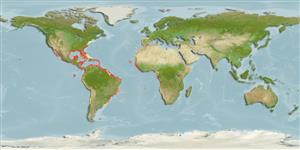
समुद्री; खारा प्रवाल-भित्ति संयुक्त; औशिनोड़िरोमस (Ref. 51243); गहराई सीमा 0 - 92 m (Ref. 244). Subtropical; 45°N - 33°S, 114°W - 14°E (Ref. 55192)
Western Atlantic: New Jersey, USA to southern Brazil, including the Gulf of Mexico, the Bahamas, and the Caribbean; also in Gulf of Mexico (Ref. 26938). Northeast Atlantic: Senegal, Côte d'Ivoire and probably wide-ranging off West Africa, but this requires confirmation. Eastern Pacific: southern Baja California, Mexico and the Gulf of California to Ecuador.
प्रथम परिपक्वता पर लंबाई / आकार / वज़न / आयु
परिपक्व अवधि: Lm ?, range 239 - ? cm
Max length : 340 cm TL पुल्लिंग / अलिंग; (Ref. 26938); common length : 240 cm TL पुल्लिंग / अलिंग; (Ref. 5217); अधिकतम प्रकाशित वज़न: 183.7 kg (Ref. 40637); अधिकतम सूचित उम्र: 25 वर्षो (Ref. 31395)
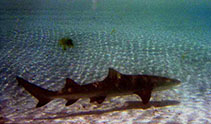
A brownish shark with yellow overtones but no conspicuous markings. Large second dorsal fin nearly same size as first dorsal (Ref. 26938).
Body shape (shape guide): fusiform / normal.
Occurs on continental and insular shelves, frequenting mangrove fringes, coral keys, docks, sand or coral mud bottoms, saline creeks, enclosed bays or sounds, and river mouths. May enter fresh water. Occasionally moves into the open ocean, near or at the surface, apparently for purposes of migration. May rest motionless on the bottom (Ref. 9710). May occur singly or in small groups. Feeds mainly on fish but also takes crustaceans and mollusks. Viviparous, with 4 to 17 young in a litter. Size at birth 60 to 65 cm. Has been involved in several attacks on people. Meat is utilized for human consumption, hides for leather, fins for shark-fin soup base, liver oil for vitamins, and carcasses for fish meal. Marketed fresh, dried-salted and frozen (Ref. 9987).
Distinct pairing with embrace (Ref. 205). Viviparous, placental (Ref. 50449), with 5 to 17 embryos (Ref. 9253). Both male and female during precopulatory and courtship swim with body axes in parallel (Ref. 49562, 51112). During copulation, the pair performs coordinated swimming (Ref. 49562, 51112).
Compagno, L.J.V., 1984. FAO Species Catalogue. Vol. 4. Sharks of the world. An annotated and illustrated catalogue of shark species known to date. Part 2 - Carcharhiniformes. FAO Fish. Synop. 125(4/2):251-655. Rome: FAO. (Ref. 244)
आईयूसीएन रेड लिस्ट स्थिति (Ref. 130435: Version 2025-2 (Global))
मानव उपयोग
मात्स्यिकी: व्यापारिक; आखेट मत्स्य: हां
साधन
विशेष रिपोर्ट
XML डाउनलोड करें
इंटरनेट स्रोत
मॉडल पर आधारित अनुमान
पसंदीदा तापमान (संदर्भ
123201): 21.9 - 28, mean 25.6 °C (based on 714 cells).
जातिवृति विविधता सूचकांक (संदर्भ
82804): PD
50 = 0.7500 [Uniqueness, from 0.5 = low to 2.0 = high].
Bayesian length-weight: a=0.00525 (0.00276 - 0.00996), b=3.09 (2.93 - 3.25), in cm total length, based on LWR estimates for this species & (Sub)family-body (Ref.
93245).
ट्रॉफिक स्तर (संदर्भ
69278): 4.3 ±0.5 se; based on diet studies.
Generation time: 9.2 ( na - na) years. Estimated as median ln(3)/K based on 1
growth studies.
लौटाव (संदर्भ
120179): बहुत नीचे, न्यूनतम जनसंख्या दुगनी समय अवलागत 14 महीने। (K=0.54(?); tm=12.7; tmax=25; Fec = 4-17; rmax = 0.012).
मछली पकड़ने की भेद्यता (Ref.
59153): High to very high vulnerability (73 of 100).
🛈
जलवायु भेद्यता (Ref.
125649): Very high vulnerability (76 of 100).
🛈
पोषक तत्व (Ref.
124155): Calcium = 2.73 [0.51, 15.56] mg/100g; Iron = 0.307 [0.074, 0.937] mg/100g; Protein = 22.4 [20.0, 24.6] %; Omega3 = 0.145 [0.049, 0.381] g/100g; Selenium = 15.2 [4.5, 49.2] μg/100g; VitaminA = 29.7 [7.6, 116.9] μg/100g; Zinc = 0.449 [0.209, 0.900] mg/100g (wet weight);