>
Ovalentaria/misc (Various families in series Ovalentaria) >
Pomacentridae (Damselfishes) > Pomacentrinae
Etymology: Amphiprion: Greek, amphi = on both sides + Greek, prion, -onos = saw (Ref. 45335).
More on author: Lacepède.
Ambiente: milieu / zona climatica / distribuzione batimetrica / gamma di distribuzione
Ecologia
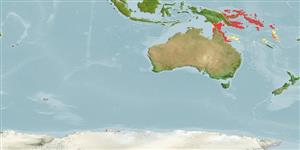
marino associati a barriera corallina; non migratori; distribuzione batimetrica 1 - 15 m (Ref. 9710). Tropical; 6°S - 26°S, 141°E - 155°E (Ref. 55268)
Western Pacific: Queensland and Melanesia including northern Great Barrier Reef, northern New Guinea, New Britain, Solomon Islands and Vanuatu. Not known from New Caledonia and the Fiji Islands, although Fowler (1959) recorded it from the latter area. Often confused with Amphiprion ocellaris.
Lunghezza alla prima maturità / Dimensione / Peso / Età
Maturità: Lm ?, range 5 - ? cm
Max length : 11.0 cm TL maschio/sesso non determinato; (Ref. 9710)
Breve descrizione
Chiavi di identificazione | Morfologia | Morfometria
Spine dorsali (totale) : 9 - 10; Raggi dorsali molli (totale) : 14 - 17; Spine anali: 2; Raggi anali molli: 11 - 13.
Body shape (shape guide): fusiform / normal; Cross section: compressed.
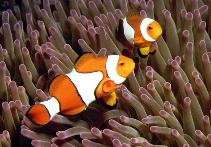
Adults inhabit lagoon and seaward reefs (Ref. 9710). Each group of fish consists of a breeding pair and 0-4 non-breeders. Within each group there is a size-based hierarchy: the female is largest, the male is second largest, and the non-breeders get progressively smaller as the hierarchy is descended. If the female dies, the male changes sex and becomes the breeding female, while the largest non-breeder becomes the breeding male. The maintenance of size differences may avoid conflicts, because subordinates do not become a threat to their dominants (Ref. 47841). Oviparous, distinct pairing during breeding (Ref. 205). Eggs are demersal and adhere to the substrate (Ref. 205). Males guard and aerate the eggs (Ref. 205). Maybe found in shallower depths than A. ocellaris. Associated with the anemones: Heteractis crispa, Heteractis magnifica, and Stichodactyla gigantea (Ref. 5911). This species has been reared in captivity (Ref. 35404, 35413, 35420).
Ciclo vitale e comportamento di accoppiamento
Maturità | Riproduzione | Deposizione | Uova | Fecondità | Larve
Each group of fish consists of a breeding pair and 0-4 non-breeders. Within each group there is a size-based hierarchy: the female is largest, the male is second largest, and the non-breeders get progressively smaller as the hierarchy is desceded. If the female dies, the male changes sex and becomes the breeding female, while the largest non-breeder becomes the breeding male (Ref. 47841). Oviparous, distinct pairing during breeding (Ref. 205). Eggs are demersal and adhere to the substrate (Ref. 205). Males guard and aerate the eggs (Ref. 205). Also Ref. 7471.
Allen, G.R., 1991. Damselfishes of the world. Mergus Publishers, Melle, Germany. 271 p. (Ref. 7247)
Stato della Lista Rossa IUCN (Ref. 130435: Version 2025-2 (Global))
Minaccia per l'uomo
Harmless
Usi umani
Pesca: di nessun interesse; Acquario: Commerciale
Strumenti
Rapporti speciali
Scarica XML
Fonti Internet
Stime basate su modelli
Temperatura preferita (Fonte Biblio.
123201): 25.5 - 28.4, mean 27.3 °C (based on 198 cells).
Indice di diversità filogenetica (Fonte Biblio.
82804): PD
50 = 0.5000 [Uniqueness, from 0.5 = low to 2.0 = high].
Bayesian length-weight: a=0.01445 (0.00624 - 0.03346), b=3.00 (2.81 - 3.19), in cm total length, based on LWR estimates for this (Sub)family-body shape (Ref.
93245).
Livello trofico (Fonte Biblio.
69278): 2.7 ±0.3 se; based on size and trophs of closest relatives
Resilienza (Fonte Biblio.
120179): Alto, tempo minimo di raddoppiamento della popolazione meno di 15 mesi (Preliminary K or Fecundity.).
Vulnerabilità della pesca (Ref.
59153): Low vulnerability (10 of 100).
🛈
Nutrienti (Ref.
124155): Calcium = 123 [67, 201] mg/100g; Iron = 0.844 [0.521, 1.333] mg/100g; Protein = 18.5 [17.4, 19.5] %; Omega3 = 0.134 [0.083, 0.212] g/100g; Selenium = 20.7 [12.1, 37.7] μg/100g; VitaminA = 126 [41, 390] μg/100g; Zinc = 2.28 [1.58, 3.16] mg/100g (wet weight);