Entorno: milieu / zona climática / rango de profundidad / gama de distribución
Ecología
marino; salobre asociado a arrecife; no migratorio (Ref. 52884); rango de profundidad 3 - 100 m (Ref. 9710). Tropical
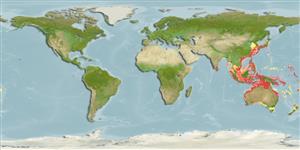
Western Pacific: central Honshu, Japan to Taiwan and the Philippines. Also occurs in Indonesia and northwestern Australia, a new record for the northeastern Indian Ocean (Ref. 5978).
Tamaño / Peso / Edad
Madurez: Lm ? range ? - ? cm
Max length : 12.0 cm TL macho / no sexado; (Ref. 559); common length : 8.0 cm TL macho / no sexado; (Ref. 9137); peso máximo publicado: 25.00 g (Ref. 131261)
Descripción breve
Claves de identificación | Morfología | Morfometría
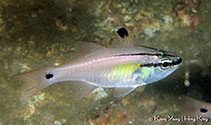
Espinas dorsales (total) : 8; Radios blandos dorsales (total) : 9; Espinas anales: 2; Radios blandos anales: 8. Upper jaw tips of breeding pair protrude. Attains 12 cm TL.
Body shape (shape guide): short and / or deep; Cross section: compressed.
May enter semi-enclosed sea areas; forms schools over rocky bottoms (Ref. 11230). Nocturnal species (Ref. 7300). Breeding pairs are found from July to September in Japan. Mouth brooding is done by the male (Ref. 240). Monogamous and always in home-ranging pairs, that is they do not defend an exclusive territory (Ref. 52884).
Ciclo vital y comportamiento de apareamiento
Madurez | Reproducción | Puesta | Huevos | Fecundidad | Larva
Mouthbrooders (Ref. 240). Distinct pairing during courtship and spawning (Ref. 205). Displays obligate monogamy where a one-to-one pair is established irrespective of resource abundance (Ref. 52884).
Masuda, H., K. Amaoka, C. Araga, T. Uyeno and T. Yoshino, 1984. The fishes of the Japanese Archipelago. Vol. 1. Tokai University Press, Tokyo, Japan. 437 p. (text). (Ref. 559)
Situación en la Lista Roja de la UICN (Ref. 130435: Version 2025-2 (Global))
Amenaza para el ser humano
Harmless
Usos humanos
Pesquerías: pesquerías de subsistencia
Herramientas
Informes especiales
Descargar XML
Fuentes de Internet
Estimaciones basadas en modelos
Temperatura preferida (Referencia
123201): 22.1 - 28.9, mean 27.6 °C (based on 824 cells).
Índice de diversidad filogenética (Referencia
82804): PD
50 = 0.5000 [Uniqueness, from 0.5 = low to 2.0 = high].
Bayesian length-weight: a=0.01202 (0.00749 - 0.01931), b=3.04 (2.91 - 3.17), in cm total length, based on LWR estimates for this species & Genus-body shape (Ref.
93245).
Nivel trófico (Referencia
69278): 3.5 ±0.0 se; based on diet studies.
Resiliencia (Referencia
120179): Alto, población duplicada en un tiempo mínimo inferior a 15 meses (Preliminary K or Fecundity.).
Vulnerabilidad pesquera (Ref.
59153): Low vulnerability (10 of 100).
🛈
Nutrientes (Ref.
124155): Calcium = 113 [55, 189] mg/100g; Iron = 0.849 [0.489, 1.494] mg/100g; Protein = 18.8 [17.7, 20.0] %; Omega3 = 0.153 [0.085, 0.275] g/100g; Selenium = 36.8 [17.7, 72.9] μg/100g; VitaminA = 54.8 [14.4, 202.9] μg/100g; Zinc = 1.76 [1.16, 2.56] mg/100g (wet weight);