Ambiente: milieu / zona climatica / distribuzione batimetrica / gamma di distribuzione
Ecologia
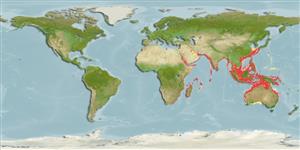
marino; salmastro associati a barriera corallina; oceanodromo (Ref. 51243); distribuzione batimetrica 20 - 200 m (Ref. 36128). Subtropical; 32°N - 35°S, 18°E - 157°E
Indo-West Pacific: Red Sea and East Africa to the Philippines, north to southern Japan and Korea, south to northern Australia. Introduced into the eastern Mediterranean Sea.
Lunghezza alla prima maturità / Dimensione / Peso / Età
Maturità: Lm 45.7 range ? - ? cm
Max length : 100.0 cm TL maschio/sesso non determinato; (Ref. 7050); common length : 60.0 cm TL maschio/sesso non determinato; (Ref. 3476); peso massimo pubblicato: 3.5 kg (Ref. 40637)
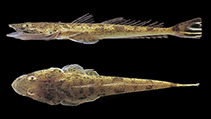
Spine dorsali (totale) : 9 - 10; Raggi dorsali molli (totale) : 13; Spine anali: 0; Raggi anali molli: 13. Brownish or grayish above, whitish below; caudal fin 2-3 horizontal black stripes (Ref. 4315). Head strongly depressed. Preopercular spines 2, lower usually longest. Vomerine teeth in a single transverse band. Dorsal fin I,VII,I, I,I,VII,I or I,VIII, 13. Anteriormost lateral line scale usually with a small spine or ridge. Diagonal scale rows slanting backward above lateral line 83-107. Iris lappet a single elongated lobe. Identified by the distinctive color pattern on the caudal fin: centrally yellow and black stripes on upper and lower margins (Ref. 48635).
Body shape (shape guide): elongated.
Found on sandy and muddy bottoms of coastal waters (Ref. 5213, 48635). Frequently in estuaries, juveniles have been taken in freshwater. Taken by handlining and seining in shallow waters and by trawling at depths to 30 m, usually less (Ref. 9790). A good food fish (Ref. 4315) that is marketed fresh (Ref. 5284). Commercially cultured in Japan. Used in Chinese medicine (Ref. 12166).
Ciclo vitale e comportamento di accoppiamento
Maturità | Riproduzione | Deposizione | Uova | Fecondità | Larve
Bauchot, M.-L., 1987. Poissons osseux. p. 891-1421. In W. Fischer, M.L. Bauchot and M. Schneider (eds.) Fiches FAO d'identification pour les besoins de la pêche. (rev. 1). Méditerranée et mer Noire. Zone de pêche 37. Vol. II. Commission des Communautés Européennes and FAO, Rome. (Ref. 3397)
Stato della Lista Rossa IUCN (Ref. 130435: Version 2025-2 (Global))
Minaccia per l'uomo
Harmless
Usi umani
Pesca: commerciale; Acquacoltura: commerciale; Pesce da pesca sportiva: si
Strumenti
Rapporti speciali
Scarica XML
Fonti Internet
Stime basate su modelli
Temperatura preferita (Fonte Biblio.
123201): 21.7 - 28.3, mean 26.5 °C (based on 979 cells).
Indice di diversità filogenetica (Fonte Biblio.
82804): PD
50 = 0.5000 [Uniqueness, from 0.5 = low to 2.0 = high].
Bayesian length-weight: a=0.00427 (0.00347 - 0.00524), b=3.10 (3.04 - 3.16), in cm total length, based on LWR estimates for this species (Ref.
93245).
Livello trofico (Fonte Biblio.
69278): 3.6 ±0.6 se; based on diet studies.
Resilienza (Fonte Biblio.
120179): Medio, tempo minimo di raddoppiamento della popolazione 1.4 - 4.4 anni (tmax=7).
Prior r = 0.64, 95% CL = 0.42 - 0.96, Based on 1 data-limited stock assessment.
Vulnerabilità della pesca (Ref.
59153): Moderate vulnerability (37 of 100).
🛈
Vulnerabilità climatica (Ref.
125649): Very high vulnerability (79 of 100).
🛈
Nutrienti (Ref.
124155): Calcium = 43.2 [3.4, 132.2] mg/100g; Iron = 1.21 [0.32, 3.24] mg/100g; Protein = 18.8 [16.5, 21.1] %; Omega3 = 0.211 [0.090, 0.614] g/100g; Selenium = 48.1 [16.2, 149.5] μg/100g; VitaminA = 28.9 [8.7, 99.7] μg/100g; Zinc = 0.763 [0.357, 1.425] mg/100g (wet weight); based on
nutrient studies.