Miljö: miljö / Klimatzon / djupintervall / distributionsområde
Ekologi
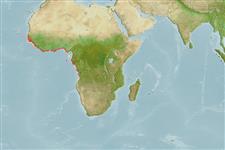
marina; sötvatten; brackvatten bottenlevande; amfidrom (Ref. 46888). Tropical; 16°N - 18°S, 19°W - 14°E
Storlek / Vikt / Ålder
Könsmognad: Lm ? range ? - ? cm
Max length : 12.4 cm TL hane/ej könsbestämd; (Ref. 57413)
Taggstrålar i ryggfenan (totalt) : 7 - 8; Mjukstrålar i ryggfenan (totalt) : 7 - 9; Taggstrålar i analfenan: 1; Mjukstrålar i analfenan: 9 - 10. Diagnosis: 14-24 predorsal scales, usually 19-22; cheek and opercle scaled (Ref. 81660). 28-33 scales in longitudinal series (including 2 or 3 scales on caudal fin base)(Ref. 57413). 8-12 scales in rearward transverse series (Ref. 57413, 81660). 1st dorsal fin: VI-VII; 2nd dorsal fin: I,7-9; anal fin: I,9-10; pectoral fins: 11-14 (Ref. 57413, 81660). Caudal fin rounded with 15 segmented rays, 13 of which are branched (Ref. 57413). Sensory canals absent on head (Ref. 57413), sensory papillae on cheek form horizontal rows (Ref. 81660). About 10 gill rakers on upper limb, and 20 on lower limb of first gill arch (Ref. 57413), 29-37 in total (Ref. 81660).
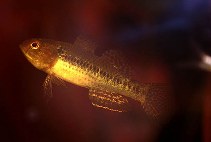
Coloration: Preserved specimens: brownish (Ref. 57413, 81660) or tan (Ref. 81660) dorsally on head and body. Ventral surface of belly pale (Ref. 57413). Most mid-lateral scales with spots equal in depth to scales forming an interrupted band extending from pectoral fin base to caudal fin base (Ref. 81660). About 2 longitudinal bands sometimes present just dorsal to midline of scales (Ref. 57413). Dark brown or black spot just posterior and dorsal to operculum (Ref. 57413), above the pectoral fin base on side of nape extending onto upper pectoral fin base (Ref. 81660), sometimes a smaller spot below this (Ref. 57413). Dorsum with 7-8 irregular dark saddles, becoming lighter ventrally below the mid-lateral row of spots; thin infraorbital bar reaching from eye just behind angle of jaw to edge of gular fold; a pair of dark bands running posteriorly from lower half of eye to edge of preopercle (Ref. 81660). Vertical brown bar at base of caudal fin (Ref. 57413). First dorsal fin with 3-4 horizontal bands, second dorsal fin with 3-4 rows of interradial spots (Ref. 81660). Caudal fin with several vertical, crescentric bands of small spots (Ref. 57413, 81660). Anal fin light brown (Ref. 57413), with 3 discretely edged horizontal bands (Ref. 81660). Pelvics light brown with central rays sometimes darker (Ref. 57413), dark line crossing bases of rays (Ref. 81660). Pectorals transparent (Ref. 57413) or dusky (Ref. 81660). Live specimens: pale olive-green on back and white on belly; red-brown spots on 1st dorsal, 2nd dorsal and anal fins, latter 2 also with light yellow spots near distal margin; caudal fin with red-brown spots near base, and yellow or orange spots posteriorly (Ref. 57413).
Body shape (shape guide): fusiform / normal.
Facultative air-breathing in the genus (Ref. 126274); Inhabits brackish water estuaries, creeks, lagoons and mangrove areas; occasionally enters freshwater (Ref. 7391, 57413, 81660). Known to be tolerant of wide range of salinity. Used as bio-control agents, e.g., use in control of mosquito larva (Ref. 42628). Endemic to West African coastline from Senegal to the Cunene River in Namibia (Ref. 92840).
Livscykel och parningsbeteende
Könsmognad | Reproduktion | Lek | Ägg | Fekunditet | Larver
Spawns in caves or on top of plants. Sometimes several females spawn with one male.
Harrison, I.J., P.J. Miller and F. Pezold, 2003. Eleotridae. p. 670-690 In C. Lévêque, D. Paugy and G.G. Teugels (eds.) Faune des poissons d'eaux douce et saumâtres de l'Afrique de l'Ouest, Tome 2. Coll. Faune et Flore tropicales 40. Musée Royal de l'Afrique Centrale, Tervuren, Belgique, Museum National d'Histoire Naturalle, Paris, France and Institut de Recherche pour le Développement, Paris, France. 815 p. (Ref. 57413)
Status på IUCN:s rödlista (Ref. 130435: Version 2025-2 (Global))
Hot mot människor
Harmless
Mänskliga användningsområden
Fiskeri: saknar intresse
Verktyg
Särskilda rapporter
Ladda ner XML
Internet-källor
Uppskattningar baserade på modeller
Önskad temperatur (Ref.
123201): 23.4 - 27.9, mean 26.5 °C (based on 64 cells).
Index för fylogenetisk mångfald (Ref.
82804): PD
50 = 0.5312 [Uniqueness, from 0.5 = low to 2.0 = high].
Bayesian length-weight: a=0.00955 (0.00531 - 0.01717), b=3.12 (2.96 - 3.28), in cm total length, based on LWR estimates for this species & (Sub)family-body (Ref.
93245).
Trofisk nivå (Ref.
69278): 2.5 ±0.23 se; based on food items.
Resiliens (Ref.
120179): Hög, lägsta populationsfördubblingstid mindre än 15 månader (Preliminary K or Fecundity.).
Sårbarhet i fisket (Ref.
59153): Low vulnerability (10 of 100).
🛈