Môi trường: môi trường / vùng khí hậu / Mức độ sâu / phạm vi phân phối
Sinh thái học
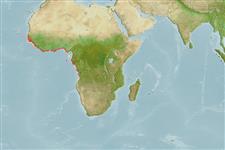
biển; nước ngọt; thuộc về nước lợ gần đáy; sống cả ở nước ngọt và nuớc mặn (Ref. 46888). Tropical; 16°N - 18°S, 19°W - 14°E
Bộ gần gũi / Khối lượng (Trọng lượng) / Tuổi
Chín muồi sinh dục: Lm ? range ? - ? cm
Max length : 12.4 cm TL con đực/không giới tính; (Ref. 57413)
Các tia vây lưng cứng (tổng cộng) : 7 - 8; Các vây lưng mềm (tổng cộng) : 7 - 9; Tia cứng vây hậu môn: 1; Tia mềm vây hậu môn: 9 - 10. Diagnosis: 14-24 predorsal scales, usually 19-22; cheek and opercle scaled (Ref. 81660). 28-33 scales in longitudinal series (including 2 or 3 scales on caudal fin base)(Ref. 57413). 8-12 scales in rearward transverse series (Ref. 57413, 81660). 1st dorsal fin: VI-VII; 2nd dorsal fin: I,7-9; anal fin: I,9-10; pectoral fins: 11-14 (Ref. 57413, 81660). Caudal fin rounded with 15 segmented rays, 13 of which are branched (Ref. 57413). Sensory canals absent on head (Ref. 57413), sensory papillae on cheek form horizontal rows (Ref. 81660). About 10 gill rakers on upper limb, and 20 on lower limb of first gill arch (Ref. 57413), 29-37 in total (Ref. 81660).
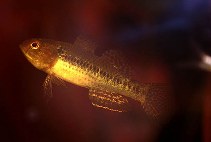
Coloration: Preserved specimens: brownish (Ref. 57413, 81660) or tan (Ref. 81660) dorsally on head and body. Ventral surface of belly pale (Ref. 57413). Most mid-lateral scales with spots equal in depth to scales forming an interrupted band extending from pectoral fin base to caudal fin base (Ref. 81660). About 2 longitudinal bands sometimes present just dorsal to midline of scales (Ref. 57413). Dark brown or black spot just posterior and dorsal to operculum (Ref. 57413), above the pectoral fin base on side of nape extending onto upper pectoral fin base (Ref. 81660), sometimes a smaller spot below this (Ref. 57413). Dorsum with 7-8 irregular dark saddles, becoming lighter ventrally below the mid-lateral row of spots; thin infraorbital bar reaching from eye just behind angle of jaw to edge of gular fold; a pair of dark bands running posteriorly from lower half of eye to edge of preopercle (Ref. 81660). Vertical brown bar at base of caudal fin (Ref. 57413). First dorsal fin with 3-4 horizontal bands, second dorsal fin with 3-4 rows of interradial spots (Ref. 81660). Caudal fin with several vertical, crescentric bands of small spots (Ref. 57413, 81660). Anal fin light brown (Ref. 57413), with 3 discretely edged horizontal bands (Ref. 81660). Pelvics light brown with central rays sometimes darker (Ref. 57413), dark line crossing bases of rays (Ref. 81660). Pectorals transparent (Ref. 57413) or dusky (Ref. 81660). Live specimens: pale olive-green on back and white on belly; red-brown spots on 1st dorsal, 2nd dorsal and anal fins, latter 2 also with light yellow spots near distal margin; caudal fin with red-brown spots near base, and yellow or orange spots posteriorly (Ref. 57413).
Body shape (shape guide): fusiform / normal.
Facultative air-breathing in the genus (Ref. 126274); Inhabits brackish water estuaries, creeks, lagoons and mangrove areas; occasionally enters freshwater (Ref. 7391, 57413, 81660). Known to be tolerant of wide range of salinity. Used as bio-control agents, e.g., use in control of mosquito larva (Ref. 42628). Endemic to West African coastline from Senegal to the Cunene River in Namibia (Ref. 92840).
Vòng đời và hành vi giao phối
Chín muồi sinh dục | Sự tái sinh sản | Đẻ trứng | Các trứng | Sự sinh sản | Ấu trùng
Spawns in caves or on top of plants. Sometimes several females spawn with one male.
Harrison, I.J., P.J. Miller and F. Pezold, 2003. Eleotridae. p. 670-690 In C. Lévêque, D. Paugy and G.G. Teugels (eds.) Faune des poissons d'eaux douce et saumâtres de l'Afrique de l'Ouest, Tome 2. Coll. Faune et Flore tropicales 40. Musée Royal de l'Afrique Centrale, Tervuren, Belgique, Museum National d'Histoire Naturalle, Paris, France and Institut de Recherche pour le Développement, Paris, France. 815 p. (Ref. 57413)
Tình trạng Sách đỏ IUCN (Ref. 130435: Version 2025-2 (Global))
Mối đe dọa đối với con người
Harmless
Sử dụng của con người
Các nghề cá: không ích lợi (thú vị)
Các công cụ
Báo cáo đặc biệt
Tải xuống XML
Các nguồn internet
Ước tính dựa trên mô hình
Nhiệt độ ưa thích (Tài liệu tham khảo
123201): 23.4 - 27.9, mean 26.5 °C (based on 64 cells).
Chỉ số đa dạng phát sinh loài (Tài liệu tham khảo
82804): PD
50 = 0.5312 [Uniqueness, from 0.5 = low to 2.0 = high].
Bayesian length-weight: a=0.00955 (0.00531 - 0.01717), b=3.12 (2.96 - 3.28), in cm total length, based on LWR estimates for this species & (Sub)family-body (Ref.
93245).
Mức dinh dưỡng (Tài liệu tham khảo
69278): 2.5 ±0.23 se; based on food items.
Thích nghi nhanh (Tài liệu tham khảo
120179): Chiêù cao, thời gian nhân đôi của chủng quần tối thiểu là dưới 15 tháng (Preliminary K or Fecundity.).
Sự dễ bị tổn thương của nghề đánh cá (Ref.
59153): Low vulnerability (10 of 100).
🛈